Costa Rica Flora: Orchids, Rainforest Plants & More
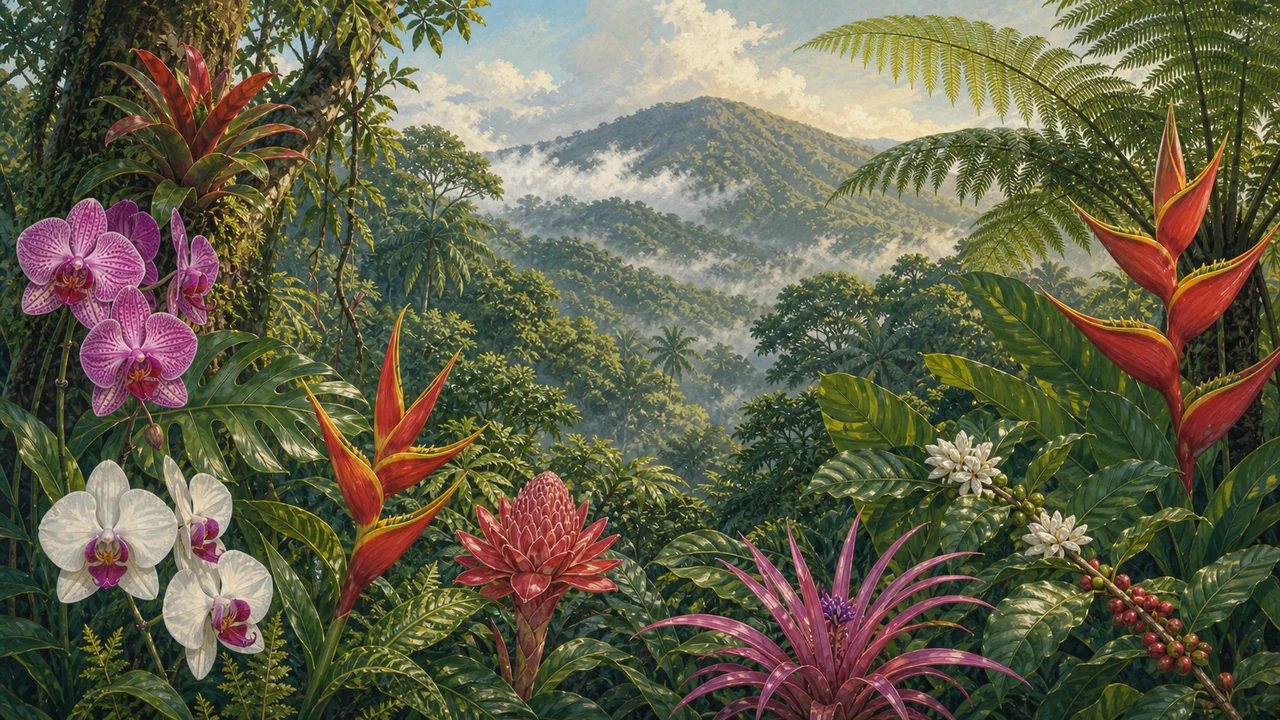 Costa Rica harbors one of the most extraordinary concentrations of plant life on the planet. Despite covering just 0.03% of Earth’s land surface, the country shelters roughly 5% of all known species — and its flora is a huge part of that story, with an estimated 10,000 or more vascular plant species packed into landscapes ranging from dry Pacific forests to dripping Caribbean rainforests and mist-shrouded cloud forests.
This remarkable diversity flows directly from geography. The country sits at the bridge between North and South America, where two continental floras overlap. Elevation varies from sea level to over 3,800 meters within short distances, creating dozens of distinct microclimates. The result is a living laboratory of plant life that draws botanists, naturalists, and curious travelers from around the world.
The Guaria Morada — Costa Rica’s National Flower
 No plant is more woven into Costa Rican identity than the guaria morada orchid, Costa Rica’s national flower. Known scientifically as Guarianthe skinneri, this elegant epiphyte produces clusters of vibrant purple-to-magenta blooms typically between February and April. In indigenous Boruca tradition it was considered sacred, and today it remains a symbol of national pride — you’ll find it decorating homes, festivals, and gardens across the country.
The guaria morada grows naturally in the dry forests of Guanacaste and the Central Valley at mid-elevations, preferring the branches of large trees where it can bask in filtered light. It is now protected under Costa Rican law, and wild collection is prohibited. Botanical gardens and orchid nurseries throughout the country cultivate it in abundance.
Costa Rica’s roughly 1,400 orchid species span every habitat in the country. Tiny, dime-sized cloud-forest orchids share space with showy lowland species. The cloud forests of Monteverde are especially celebrated — more than 500 orchid species have been recorded in that zone alone, including many that bloom at night and are pollinated by moths.
Bromeliads and Epiphytes — The Canopy’s Hidden Gardens
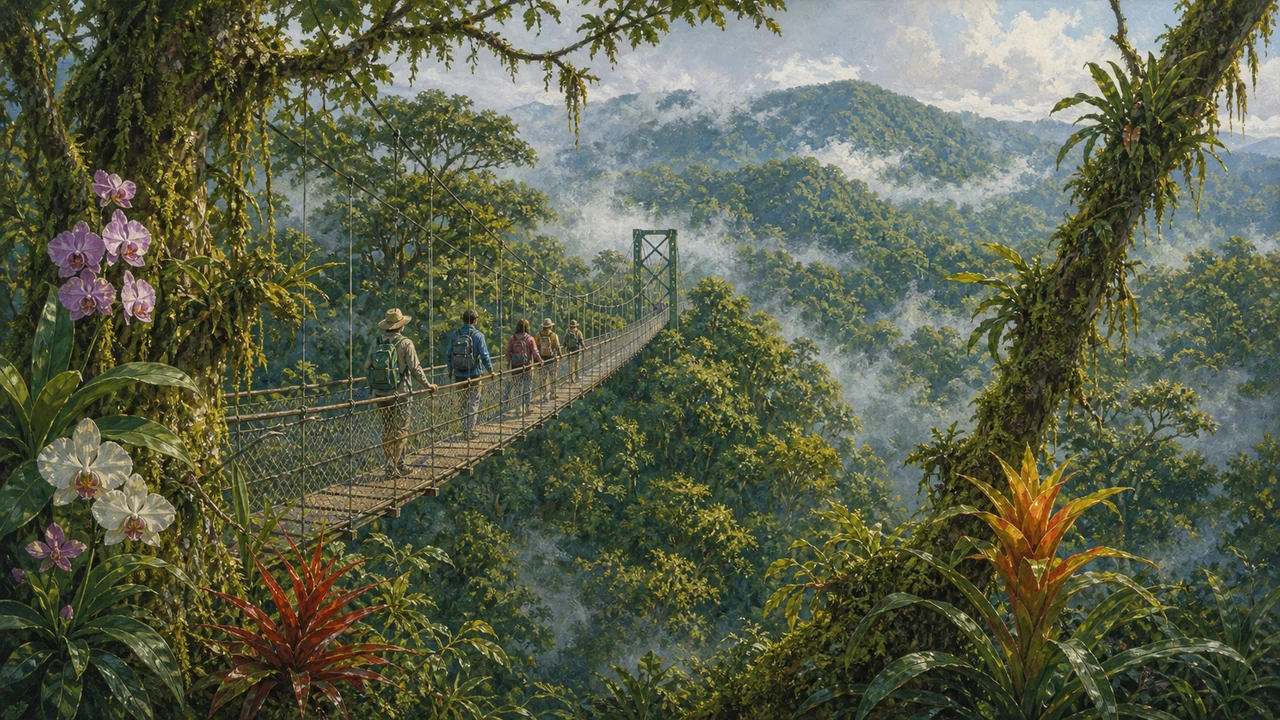 Look up in any Costa Rican forest and you’ll see the branches draped in plants growing on plants. Epiphytic bromeliads in Costa Rica’s cloud forests are among the most visually striking elements of the landscape — their stiff, overlapping leaves form water-collecting rosettes that become miniature ecosystems, sheltering frogs, insects, and salamanders entirely off the ground.
Bromeliads belong to the same family as pineapple, and Costa Rica counts hundreds of native species. Tank bromeliads in the cloud forest can hold several liters of water, creating habitat for specialized species found nowhere else. At lower elevations, tillandsias — the “air plants” — cling to branches and power lines with almost no root system at all, absorbing moisture directly from humid air.
Other major epiphyte groups include:
- Aroids (Philodendron, Monstera, Anthurium) — the giant split-leaf plants climbing tree trunks across lowland forests
- Ferns — from delicate filmy ferns in cloud forest to massive nests of elkhorn ferns at mid-elevation
- Mosses and liverworts — so thick in some cloud forests that entire branches are coated in green cushions centimeters deep
- Peperomias — a surprisingly diverse group of small succulent epiphytes adapted to dry, bark-dwelling conditions
Heliconias and Tropical Blooms
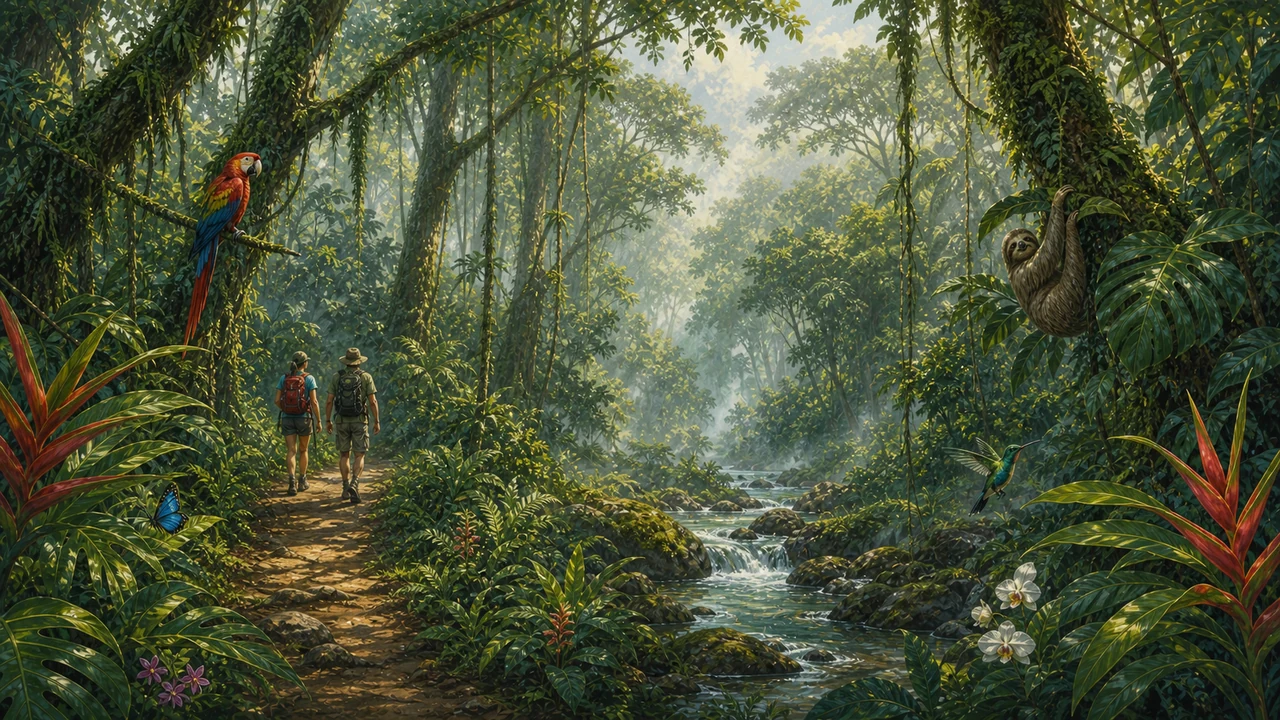 The vivid reds, oranges, and yellows of heliconia flowers in Costa Rica’s humid lowlands are among the country’s most photographed plants. These relatives of the banana family produce elaborate, waxy bracts that protect smaller true flowers inside — a brilliant evolutionary strategy that attracts hummingbirds as pollinators while keeping nectar dry and concentrated.
Costa Rica’s heliconias are particularly numerous in the Caribbean lowlands and along the Pacific slopes where rainfall is heavy. Several species are endemic or near-endemic. Their large paddle-shaped leaves also serve an important ecological function, catching rainfall and channeling water to the forest floor while providing shelter for countless insects.
Alongside heliconias, the tropical flowers that define Costa Rica’s rainforest landscape include:
- Torch ginger (Etlingera elatior) — spectacular red waxy blooms on tall stems in humid gardens and forest edges
- Lobster-claw heliconias — hanging pendant varieties whose bracts resemble crustacean claws in vivid red and yellow
- Strelitzias and gingers — widely cultivated across the country and escaped into secondary growth
- Passion flowers — intricate, alien-looking blooms in dozens of native species, each adapted to specific pollinators and butterfly larvae
The Great Trees: Ceiba and Guanacaste
Two trees stand above all others as emblems of Costa Rica’s forest heritage.
The ceiba tree (Ceiba pentandra) is the largest tree in Costa Rican forests, capable of exceeding 60 meters in height with a trunk buttressed by massive woody flanges at its base. These buttress roots spread outward for several meters, stabilizing the giant in shallow tropical soils and creating sheltered microhabitats at ground level. Ceibas were sacred to the Maya and remain ecologically critical — their canopy position makes them landmark roosting and nesting sites for macaws, harpy eagles, and countless bats that pollinate their flowers at night. You can find impressive ceibas in Corcovado National Park and along the Caribbean coast.
The guanacaste tree (Enterolobium cyclocarpum) — Costa Rica’s national tree — is a sprawling giant of the dry Pacific lowlands. Its massive, umbrella-like canopy can shade an entire pasture, and its ear-shaped seed pods gave both the tree and the province of Guanacaste their names. The Chorotega peoples of pre-Columbian times used every part of the tree — bark for medicine, pods for soap, wood for canoes. Today it is a cornerstone species in the tropical dry forest ecosystems of the Nicoya Peninsula.
Rainforest Plant Diversity — Life at Every Layer
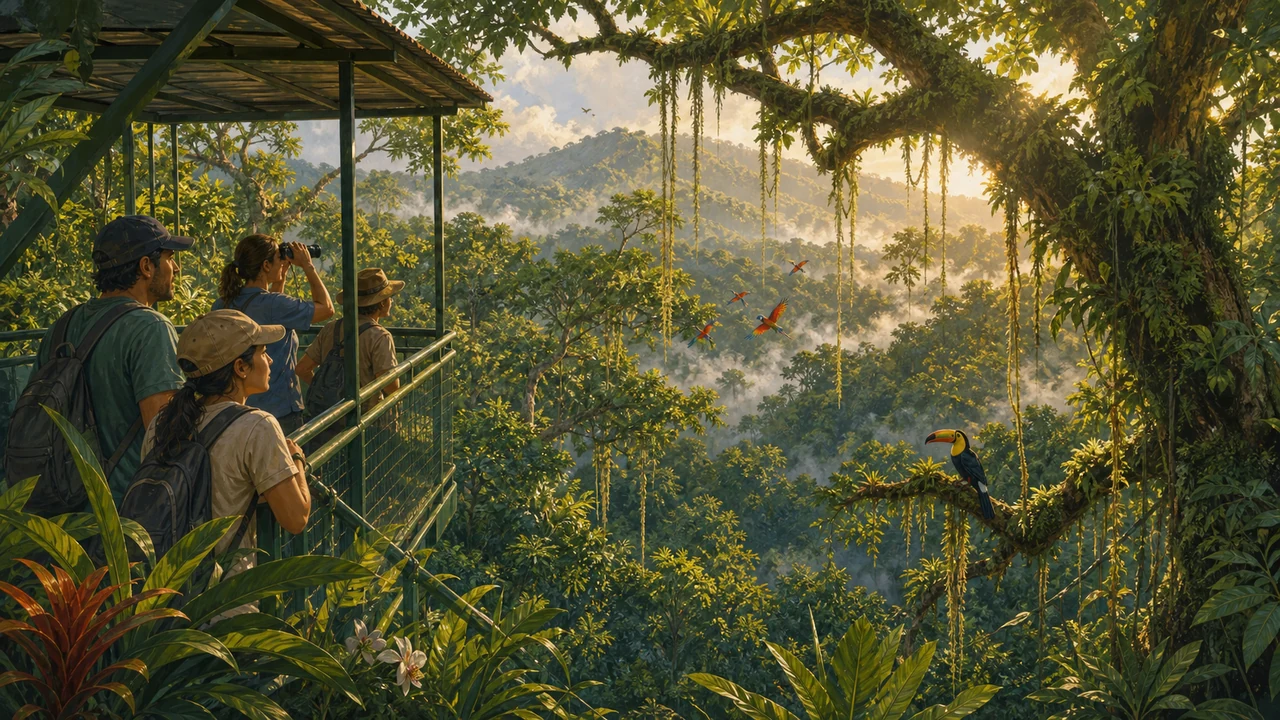 The Costa Rica rainforest is structured in vertical layers, and each layer has its own characteristic plants. The emergent layer — the topmost canopy where ceibas and the tallest trees break above the rest — receives full sun and intense rain. Below it, the closed canopy of mid-sized trees filters out 80–90% of light. The understory holds shade-adapted palms, young trees, and large-leaved aroids waiting for gaps to open. At ground level, the diverse ground-layer plants of lowland rainforest are often surprisingly sparse — the shade is simply too deep for dense undergrowth.
This stratification creates plant species diversity in Costa Rica’s rainforests that is almost incomprehensible to visitors from temperate climates. A single hectare of primary lowland forest in the Osa Peninsula may contain 200 or more tree species — more than in all of Europe. Add in the epiphytes, lianas, palms, ferns, and herbaceous plants and the number climbs higher still.
Key plant groups to watch for on a nature walk:
- Palms — from the stately royal palm to dozens of understory species; pejibaye palm (Bactris gasipaes) has been cultivated by indigenous peoples for millennia
- Lianas and woody vines — criss-cross the forest, connecting canopy layers and providing highways for monkeys and coatis
- Strangler figs — begin life as epiphytes, slowly enveloping host trees in a lattice of roots; eventually the host dies and the fig stands hollow
- Tree ferns — relics of ancient flora, dramatic in cloud forests and at higher elevations
- Wild ginger and marantaceae — carpet the forest floor in humid zones with patterned, paddle-shaped leaves
Where to See Costa Rica’s Flora
Costa Rica’s national parks and protected areas are the best places to experience the country’s plant diversity. For specific recommendations:
- Braulio Carrillo National Park — the easiest access to primary rainforest from San José; drive through on the highway and see the forest walls rising on both sides
- Tortuguero National Park — Caribbean lowland forest rich in heliconias, aroids, and wetland plants, accessible by boat
- Corcovado National Park — considered the most biologically intense rainforest on Earth; extraordinary tree diversity and giant ceibas
- Manuel Antonio National Park — accessible Pacific coast forest with excellent flora interpretation trails
- INBio Parque (near Heredia) — a purpose-built biodiversity park with labeled plant collections representing all of Costa Rica’s ecosystems
- Cloud forests — Monteverde, San Gerardo de Dota, and Los Quetzales are prime destinations for orchid and epiphyte spotting in Costa Rica’s cloud forests
The Costa Rica national flower page goes deeper on the guaria morada’s cultural significance, and the national tree page covers the guanacaste’s role as a national symbol.
For the full picture of what makes this country’s nature so extraordinary, explore the ecotourism & nature section — including the companion Costa Rica fauna guide and the rainforest section.
Frequently asked questions
What is Costa Rica's national flower?
Costa Rica's national flower is the guaria morada (Guarianthe skinneri), a striking purple-pink orchid native to Central America. It blooms in late February and March and is deeply embedded in Costa Rican cultural identity, often displayed at festivals and in homes during the flowering season.
How many orchid species are found in Costa Rica?
Costa Rica is home to roughly 1,400 orchid species, making it one of the most orchid-rich countries on Earth relative to its size. Orchids thrive across every life zone, from humid lowland rainforests up to cool cloud forests above 2,000 meters.
What is the guanacaste tree and why is it important?
The guanacaste (Enterolobium cyclocarpum) is Costa Rica's national tree — a massive, wide-canopied legume that can live for centuries. It gives the northwest province of Guanacaste its name and provides vital shade and habitat in the seasonally dry Nicoya Peninsula landscape.
Where can I see the best rainforest plants in Costa Rica?
Top spots include Corcovado National Park on the Osa Peninsula for primary rainforest, Tortuguero for lush Caribbean lowland flora, Braulio Carrillo for accessible dense jungle near San José, and the Monteverde cloud forest for spectacular epiphytes, mosses, and tree ferns.
What are epiphytes and why are they so common in Costa Rica?
Epiphytes are plants that grow on other plants without harming them — orchids, bromeliads, mosses, ferns, and aroids are all epiphytes. Costa Rica's high rainfall and humidity create ideal conditions, and a single large tree in a cloud forest may host dozens of epiphyte species on its branches.