Manuel Antonio National Park: Rainforest Meets the Beach
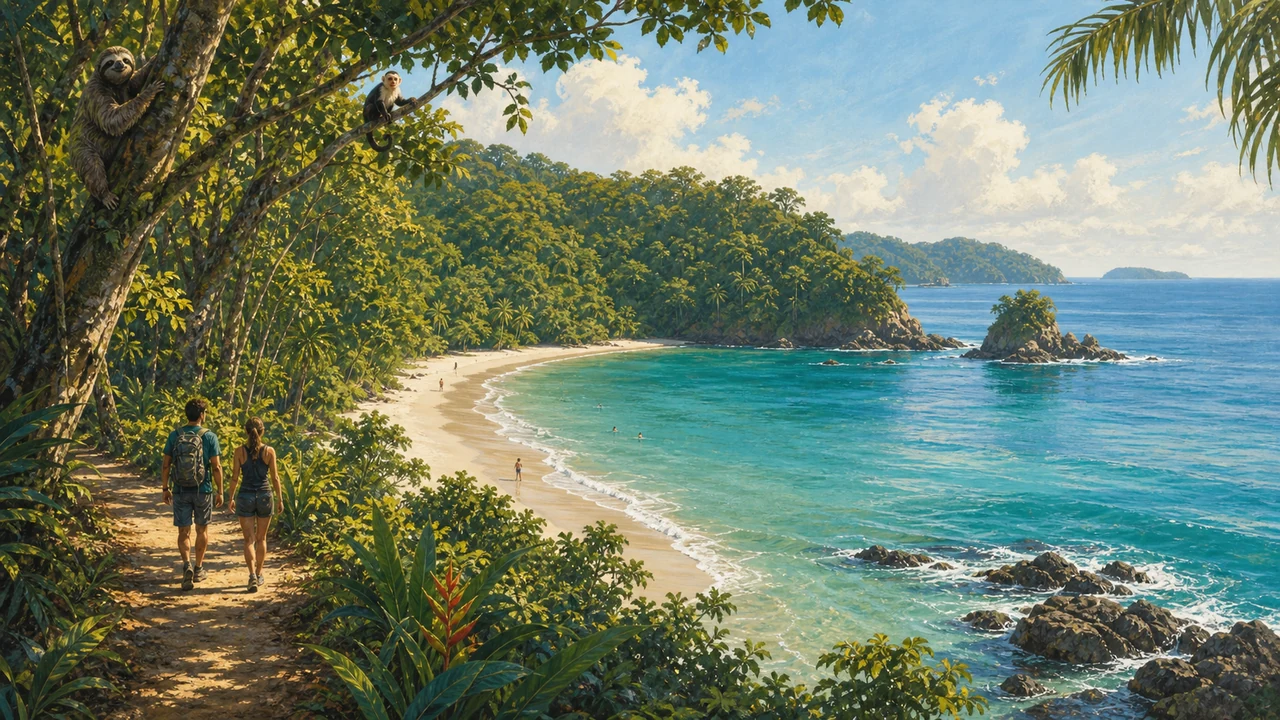 Manuel Antonio National Park is Costa Rica’s most visited protected area — and once you step onto a white-sand beach framed by dripping rainforest, it’s easy to understand why. Tucked onto a small peninsula on the Central Pacific coast, just a few kilometres south of Quepos, this compact park packs extraordinary biodiversity into every trail and shoreline.
Despite being the smallest of Costa Rica’s national parks, Manuel Antonio holds primary and secondary rainforest, mangrove swamps, coral reefs, offshore islands, and some of the country’s most beautiful beaches — all within a single visit. It was established in 1972 to protect one of the last patches of lowland Pacific rainforest in this part of the country, and it remains a cornerstone of Costa Rica’s protected areas network.
The Beaches
Three main beaches draw the crowds, each with its own character.
Playa Manuel Antonio is the park’s centrepiece: a crescent of fine white sand sheltered by a calm bay, ideal for swimming. Coral reef fringes the headlands on either side, and historic pre-Columbian fish traps are still visible among the rocks — a reminder that people have worked this coastline for centuries. Pacific green turtles and olive ridley turtles nest here seasonally.
Playa Espadilla Sur runs along the eastern flank of Punta Catedral and connects to Manuel Antonio beach at low tide. It tends to be less crowded and has a wilder feel. Playa Puerto Escondido, toward the park’s southern end near the mouth of the Río Naranjo, rewards those willing to hike a little further with near-solitude.
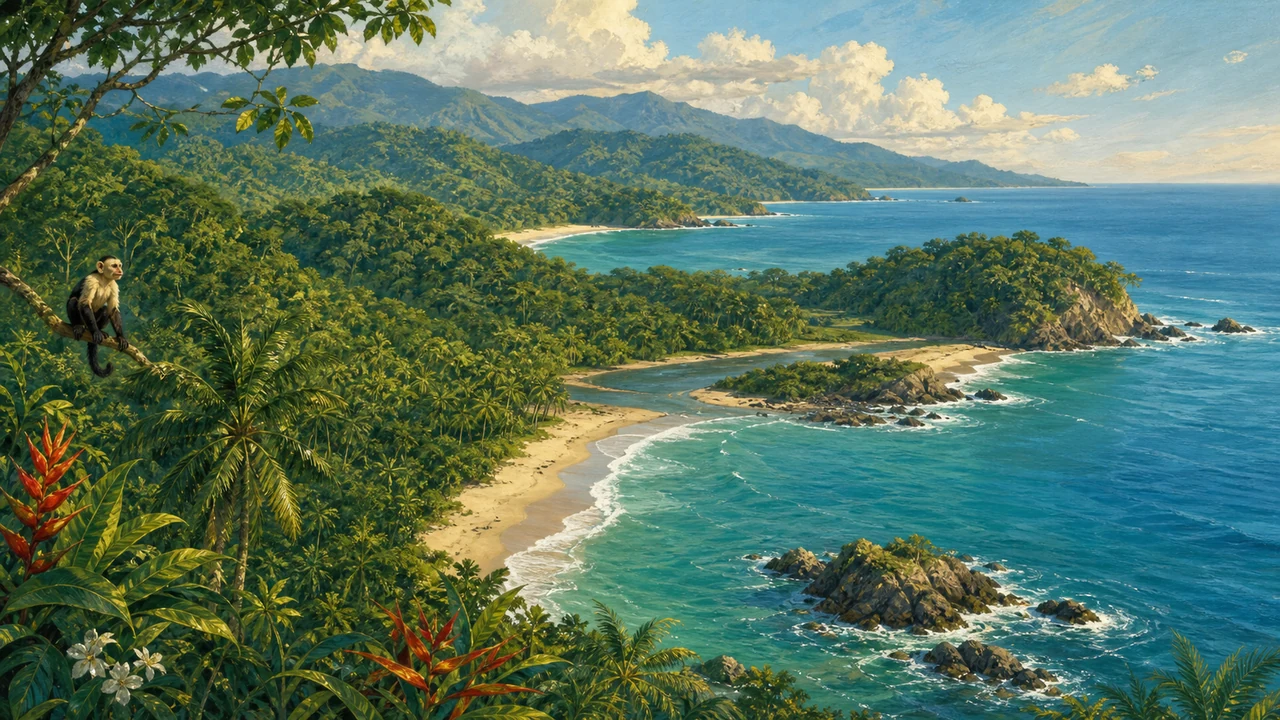
Linking all of them is Punta Catedral — a forested peninsula (once an island, now attached to the mainland by a natural sand tombolo) whose jungle-capped cliffs rise straight from the Pacific.
Wildlife: Who You’ll Meet on the Trail
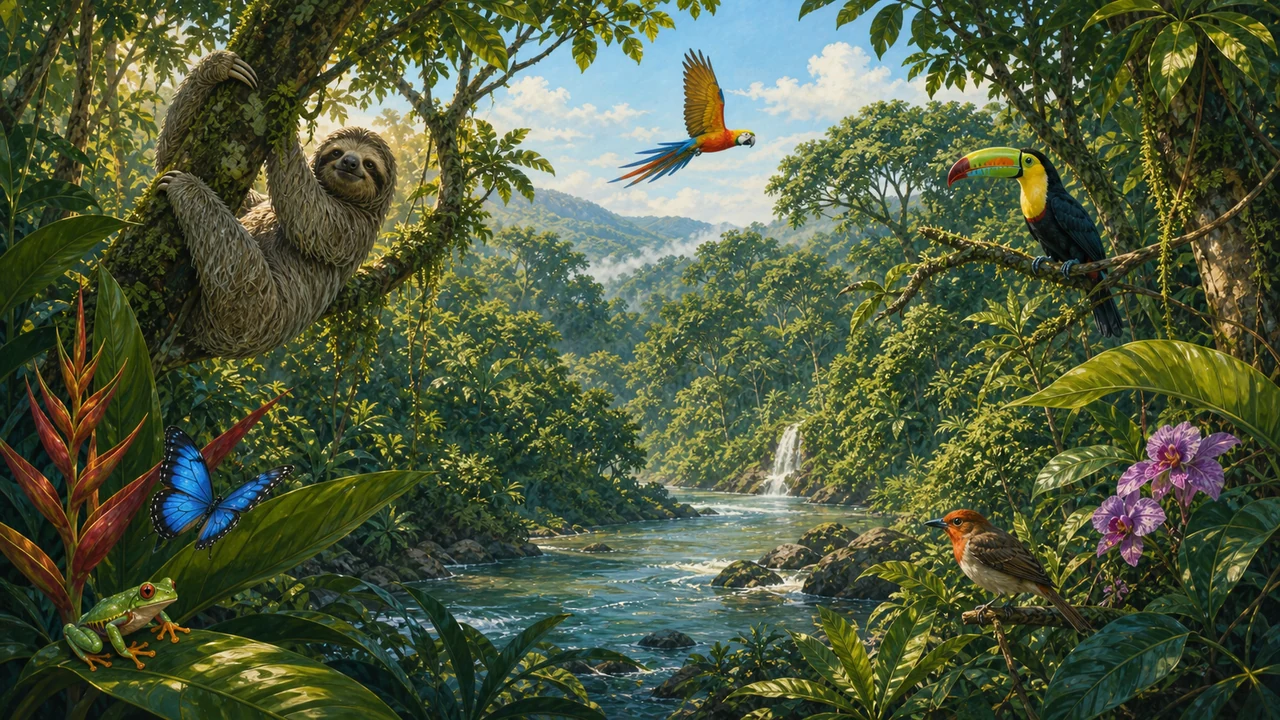 Manuel Antonio is one of the best places in Costa Rica to see wildlife in its natural habitat, with little effort. The forest is surprisingly approachable, and animals here are accustomed to respectful observers.
Monkeys are the undisputed stars. All three of Costa Rica’s Central Pacific monkey species live here:
- White-faced capuchins are bold and inquisitive — keep food secured at all times.
- Howler monkeys provide the park’s morning soundtrack, a deep territorial roar that carries for kilometres.
- Squirrel monkeys (Saimiri oerstedii citrinellus) are the rarest and most sought-after. This subspecies is endemic to a narrow coastal strip of Costa Rica and is classified as endangered. Manuel Antonio is one of the most reliable places in the world to find them.
Sloths — both two-toed and three-toed — drape themselves across cecropia and fig trees throughout the forest. A guide’s trained eye will find them in branches you’d walk right past. White-nosed coatis troop across the forest floor; iguanas bask on sunny rocks; and the mangrove edges shelter green kingfishers and black-collared hawks.
Birders should watch for brown pelicans riding thermals above the bay, frigate birds soaring over the offshore islands, toucans in the canopy, and scarlet macaws flying between fruiting trees.
Twelve small islands just offshore serve as seabird sanctuaries. Brown boobies, brown pelicans, and frigate birds nest on Isla Olocuita and Isla Mogote. The surrounding marine environment supports sponges, corals, crustaceans, and a diverse array of reef fish, making snorkelling off Manuel Antonio beach worthwhile when conditions are clear.
Trails and How to Explore
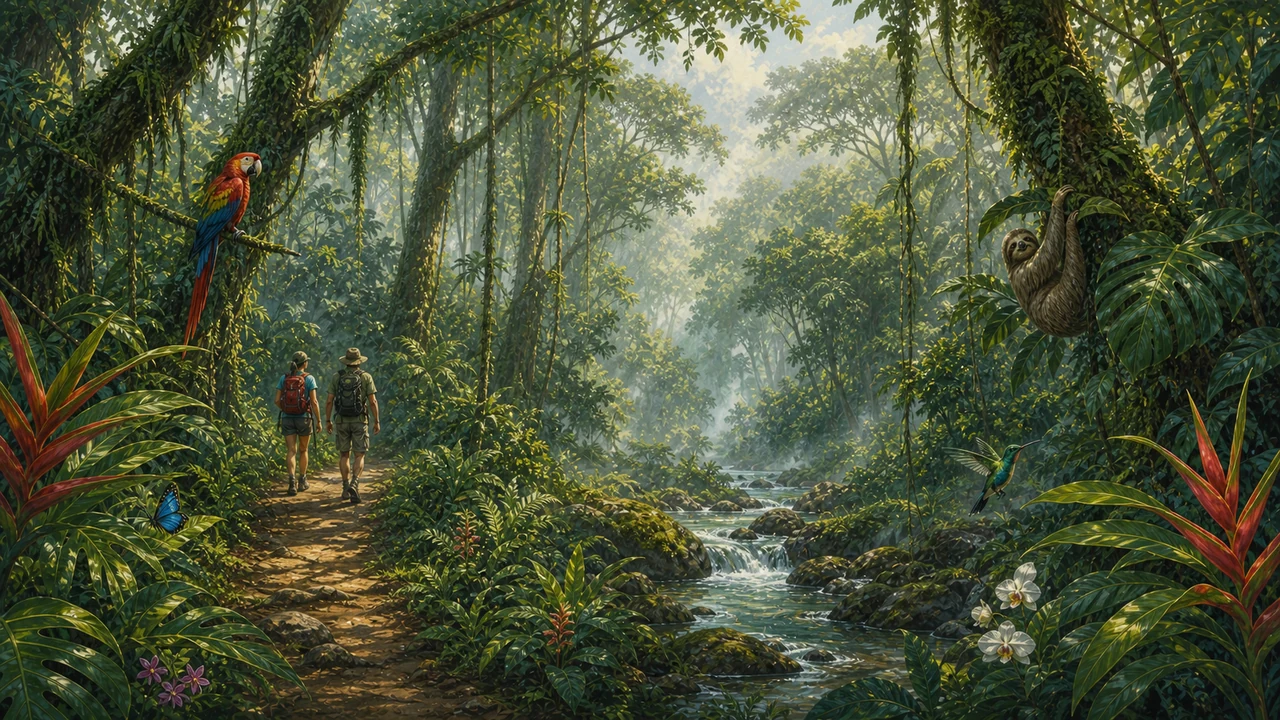 The trail network is compact, well-marked, and manageable in a half-day. Most paths are paved or compacted sand, making them accessible to most fitness levels.
- Punta Catedral Loop — the signature walk. The trail climbs through dense forest to the tip of the former island, delivering sweeping panoramic views of the Pacific, the offshore islets, and the park’s beaches below. The ascent is short but can be steep; the payoff is spectacular.
- Coastal Trail — a flat, shaded path hugging the shoreline between the main beaches, ideal for wildlife spotting at a leisurely pace.
- Lookout Trail — an observation tower mid-forest offers a 360-degree canopy-level view. An excellent spot for birding at dawn.
- Mangrove Trail — winds through a 44-hectare mangrove system of red, white, and buttonwood mangroves bordering a lagoon and estuary. A distinct ecosystem with its own cast of wading birds and resident wildlife.
Hiring a licensed naturalist guide at the park entrance is one of the best investments you can make. Guides find wildlife that most visitors walk straight past — a sloth motionless in a cecropia canopy, a tiny poison dart frog on a mossy log — and provide context that transforms a pleasant stroll into a genuine natural-history experience.
Practical Visitor Information
Getting there: Manuel Antonio sits about 175 km south of San José via the Costanera Sur highway — roughly a three-hour drive. The town of Quepos, 7 km north, serves as the gateway with hotels, restaurants, and shuttle connections. Domestic flights land at Quepos (La Managua) airport, cutting travel time significantly.
Park hours and closed days: The park is open daily except Tuesdays, when it is closed for maintenance. Hours generally run from early morning until mid-afternoon; check the current schedule with SINAC (the national parks service) before you go.
Visitor limits: Daily entry is capped to protect the ecosystem. Reservations through the SINAC online booking system are strongly recommended and sometimes required, particularly during peak season (December through April) and Costa Rican holiday weeks. Walk-up entry is often unavailable on busy days.
What to bring: Light, quick-dry clothing; reef-safe sunscreen (to protect the coral); insect repellent; water; and closed-toe shoes for the trails. Pack everything in a daypack — there are no long distances, but the humidity can be intense.
Best time to visit: The dry season (December–April) brings reliable sunshine and calmer seas, which is when the park is at its busiest. The green season (May–November) sees fewer crowds, lower rates in nearby hotels, and lush, intensely green forest — wildlife is just as abundant and rain showers typically pass quickly.
Beyond the Park Boundary
 The Manuel Antonio area offers far more than the park itself. Quepos is a relaxed coastal town with good restaurants, a lively fish market, and easy access to the marina. Along the road between Quepos and the park entrance, a string of hotels, restaurants, and tour operators cater to every budget.
Popular activities bookable locally include:
- Snorkelling and scuba diving around the park’s offshore reef and nearby Caño Island
- Sea kayaking along the coastline and into the mangrove channels
- White-water rafting on the Río Naranjo and Río Savegre
- Sailing and dolphin-watching tours in the Damas estuary and open Pacific
- Sport fishing out of Quepos marina, one of Central Pacific’s premier sailfish destinations
For the broader Costa Rica ecotourism and nature experience, Manuel Antonio makes an excellent base. Day trips reach nearby wetlands, coffee farms in the hills, and the mangrove-rich Damas Island estuary by boat.
If you’re planning a full itinerary, consider pairing Manuel Antonio with activities and sports elsewhere on the Central Pacific coast, or combining it with a national parks circuit that includes Carara to the north — famous for scarlet macaws — or Corcovado to the south for a true wilderness experience. Travel tips for getting around Costa Rica will help you make the most of the journey between parks.
Manuel Antonio rewards everyone: families seeking an approachable introduction to tropical wildlife, photographers chasing that perfect sloth shot, beach lovers who don’t want to stray far from the shade of a palm. In a country that has made conservation a national identity — protecting more than a quarter of its territory — this small park on a Pacific peninsula stands as one of the most eloquent arguments for why that commitment matters.
Frequently asked questions
What days is Manuel Antonio National Park closed?
The park is closed on Tuesdays. Plan your visit for any other day of the week, and arrive early — daily visitor numbers are capped to protect the ecosystem.
What wildlife can I see at Manuel Antonio?
White-faced capuchin, howler, and spider monkeys are common. The endangered squirrel monkey (found only in this region of Costa Rica) is a highlight. You'll also spot two-toed sloths, coatis, iguanas, toucans, scarlet macaws, and numerous shorebirds.
How do I get to Manuel Antonio from San José?
Manuel Antonio is roughly 175 km south of San José, near the town of Quepos. The drive takes about three hours via the Central Pacific highway. Shared shuttles, private transfers, and domestic flights to Quepos (QEP) are all options.
Are the beaches inside the park swimmable?
Yes. Playa Manuel Antonio is the most popular beach and is generally calm and safe for swimming. Playa Espadilla Sur and Playa Puerto Escondido offer more seclusion. Always check current conditions and posted lifeguard flags.
Do I need to book park entry in advance?
Entry is limited to a set number of visitors per day, so booking ahead through the SINAC reservation system is strongly recommended, especially during high season (December–April). Check current fees and booking procedures on the official SINAC website before you visit.