Costa Rica's National Coat of Arms: Symbols & Meaning
Costa Rica’s national coat of arms (escudo nacional) is one of the most information-rich national symbols in Latin America, encoding the country’s geography, history, and values into a single image. Every element — from the three volcanoes rising between two oceans to the seven gold stars hovering above — tells a precise story about who Costa Ricans are and what they stand for.
History and Decrees
President José María Castro Madriz signed the decree creating the national shield on September 29, 1848, the same year Costa Rica declared itself a republic independent from the Central American Federation. The design drew on the heraldic traditions of the era, depicting the country’s geography and aspirations in a formal oval coat of arms.
The shield has been officially revised twice since then. In 1906, all military iconography — cannons, rifles, and other weapons of war — was stripped from the design. That decision was a deliberate statement: Costa Rica wanted to be seen as a peaceful republic, not a martial one. The revision foreshadowed the even bolder move of 1948, when the country abolished its army entirely, making it one of the few nations in the world with no standing military.
The second revision came in 1964, when two additional gold stars were added to reflect the elevation of Limón and Puntarenas to full provincial status, bringing the total to seven stars for seven provinces.
The Full Design, Element by Element
The coat of arms is an oval shield framed by two branches of myrtle. Inside the oval, the landscape is divided horizontally into sky above and geography below.
The blue ribbon at the top reads “América Central” in silver letters, placing Costa Rica firmly within its regional context. Below that, the scene unfolds:
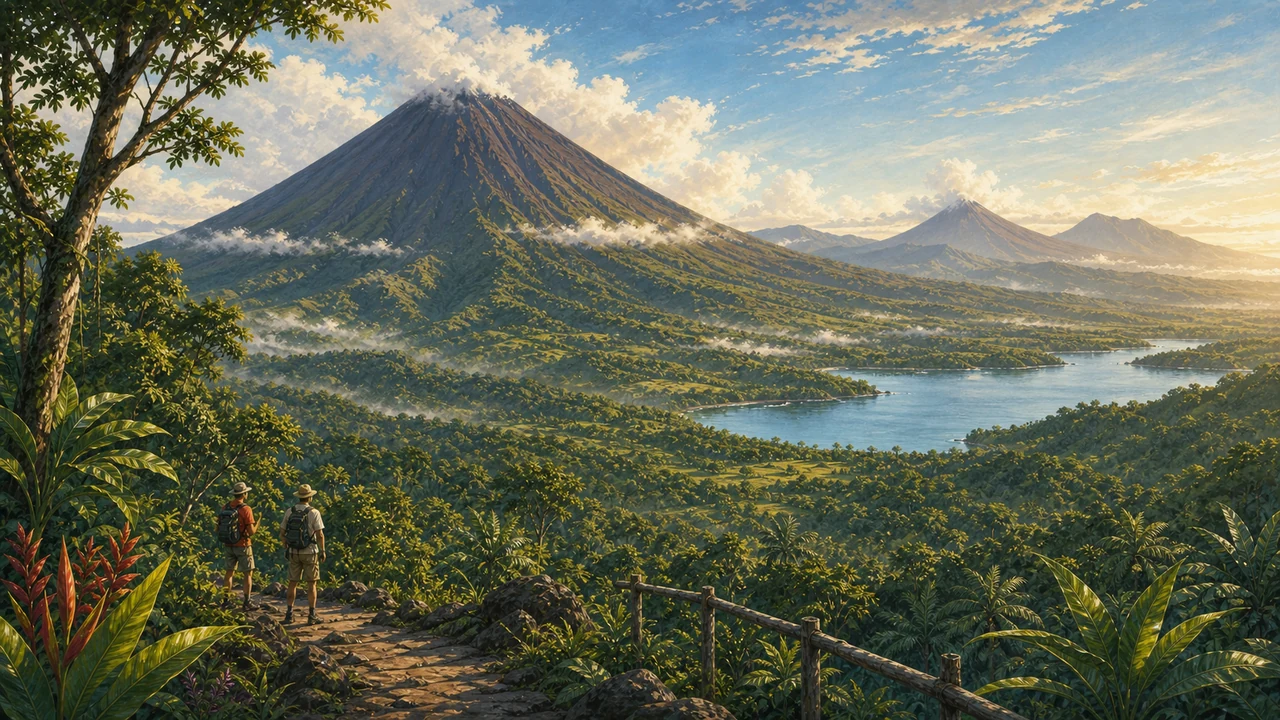
- Three volcanoes rise at the center, representing the Guanacaste, Central, and Talamanca mountain cordilleras. The volcanoes form a valley between them — a nod to the Valle Central, the highland basin where the majority of Costa Ricans have lived since colonial times. Visitors who want to explore these peaks can learn more about Costa Rica’s active and dormant volcanic landscape.
- Two oceans — the Pacific to the left and the Atlantic (Caribbean) to the right — flank the volcanoes. Costa Rica’s position as a narrow land bridge between two great oceans has defined its ecology, trade, and culture for centuries.
- Two merchant ships, one on each ocean, symbolize the country’s commercial and cultural openness to the world.
- A rising sun arcs above the volcanoes, representing national prosperity and the promise of a bright future.
The Seven Stars and the Provinces
Seven five-pointed gold stars arc above the volcanoes, one for each province:
- Alajuela — the agricultural heartland, home to Juan Santamaría International Airport
- Cartago — the colonial-era capital, famous for its basilica and fertile valleys
- Guanacaste — the dry Pacific northwest, known for ranching, beaches, and the guanacaste tree
- Heredia — coffee country north of San José
- Limón — the Caribbean coast province, culturally distinct and biologically extraordinary
- Puntarenas — the long Pacific coast province stretching from the Gulf of Nicoya to the Osa Peninsula
- San José — the capital province and national administrative center
The seven-star configuration is one of the most recognizable features of the Costa Rica national coat of arms meaning, and it appears on government documents, currency, and official seals throughout the country.
The Coffee Branches and the White Ribbon
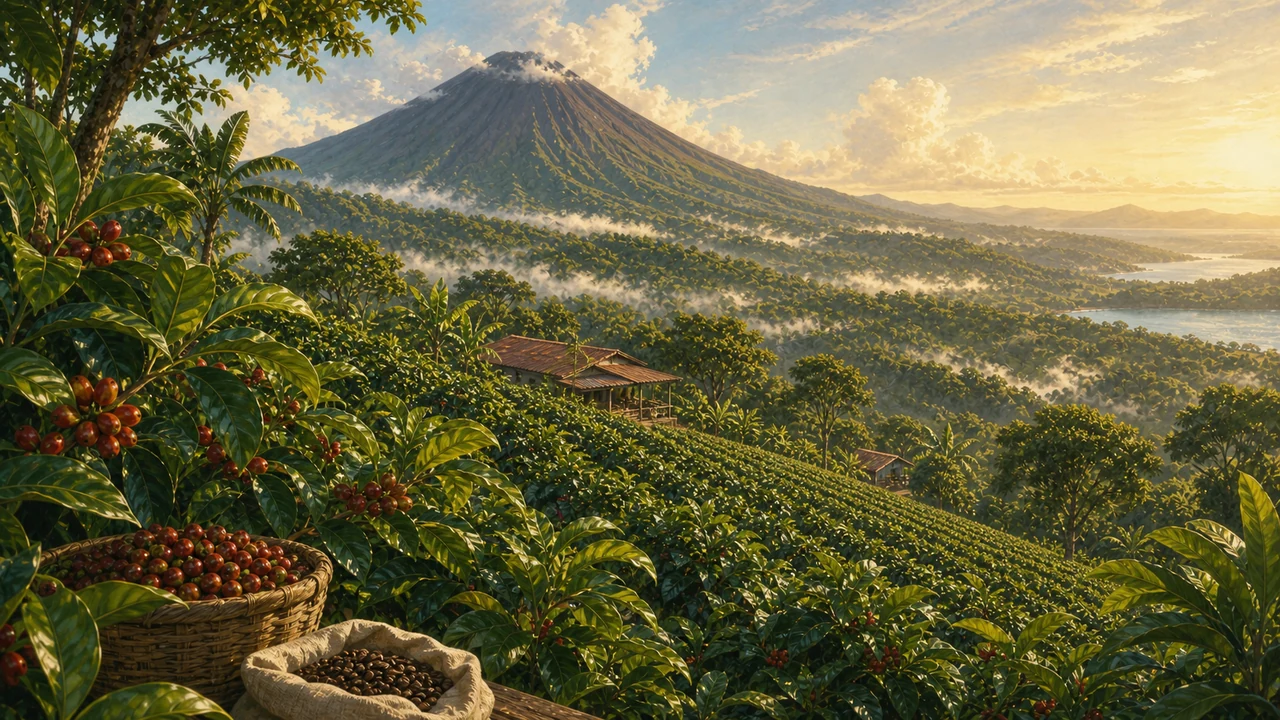
Two branches heavy with coffee berries frame the bottom of the shield, and a white ribbon joins them beneath the oval. The ribbon is inscribed with “República de Costa Rica” in gold letters.
The coffee branches are one of the most historically charged elements of the design. Costa Rica’s coffee industry was the engine of the country’s 19th-century development — it funded roads, the National Theater in San José, and the first public schools. By placing coffee front and center on the national shield, the founders acknowledged that Costa Rican coffee cultivation and national identity were inseparable. Today the country continues to be celebrated for its high-altitude specialty coffee, grown in the same volcanic soils depicted in the shield above.
The myrtle branches encircling the oval carry their own symbolism: myrtle has been a traditional symbol of peace and victory in Western heraldry since classical antiquity, reinforcing the peaceful character that Costa Rican governments have emphasized since the 1906 redesign.
Peaceful Roots, Modern Pride
The evolution of the escudo de Costa Rica from a militaristic 1848 original to the peaceful, democratic symbol it is today mirrors the country’s own trajectory. Removing weapons in 1906, abolishing the army in 1948, and recognizing new provinces in 1964 — each revision made the shield more honest about what Costa Rica had become.
Today the coat of arms appears alongside the Costa Rica national flag on all official state documents and is displayed prominently in government buildings, schools, and embassies worldwide. For visitors, it offers a compact visual summary of the country’s core identity: a small, biodiverse nation wedged between two oceans, built on volcanic soil, peaceful by principle, and quietly proud of it.
To explore more of what makes Costa Rica distinctive, browse the country’s other national symbols, from the national bird and national flower to the national tree, or dive deeper into the general information about Costa Rica that shapes every traveler’s first impression of this remarkable country.
Frequently asked questions
What do the three volcanoes on Costa Rica's coat of arms represent?
The three volcanoes represent Costa Rica's three main mountain-range systems: the Guanacaste, Central, and Talamanca cordilleras. Together they form a central valley that historically divided the country and shaped its population centers.
How many stars are on Costa Rica's national shield and what do they mean?
There are seven gold stars, one for each of Costa Rica's seven provinces: Alajuela, Cartago, Guanacaste, Heredia, Limón, Puntarenas, and San José. Two stars were added in 1964 when Limón and Puntarenas achieved full provincial status.
What do the two ships on the coat of arms symbolize?
A merchant vessel sails on each ocean — the Pacific on the left and the Atlantic (Caribbean) on the right. They represent Costa Rica's openness to international trade and its cultural exchange with the wider world.
When was Costa Rica's national shield created and has it changed?
President José María Castro Madriz decreed the original shield on September 29, 1848. It was redesigned in 1906, when all military imagery (cannons, rifles) was removed, and again in 1964, when two stars were added for the new provinces.
What do the coffee branches on the coat of arms represent?
Clusters of coffee berries — often called 'golden beans' — flank both sides of the shield. They are a direct tribute to the coffee industry that drove Costa Rica's economic development and prosperity throughout the 19th and 20th centuries.