Birds of Costa Rica: Species, Families & Where to Find Them
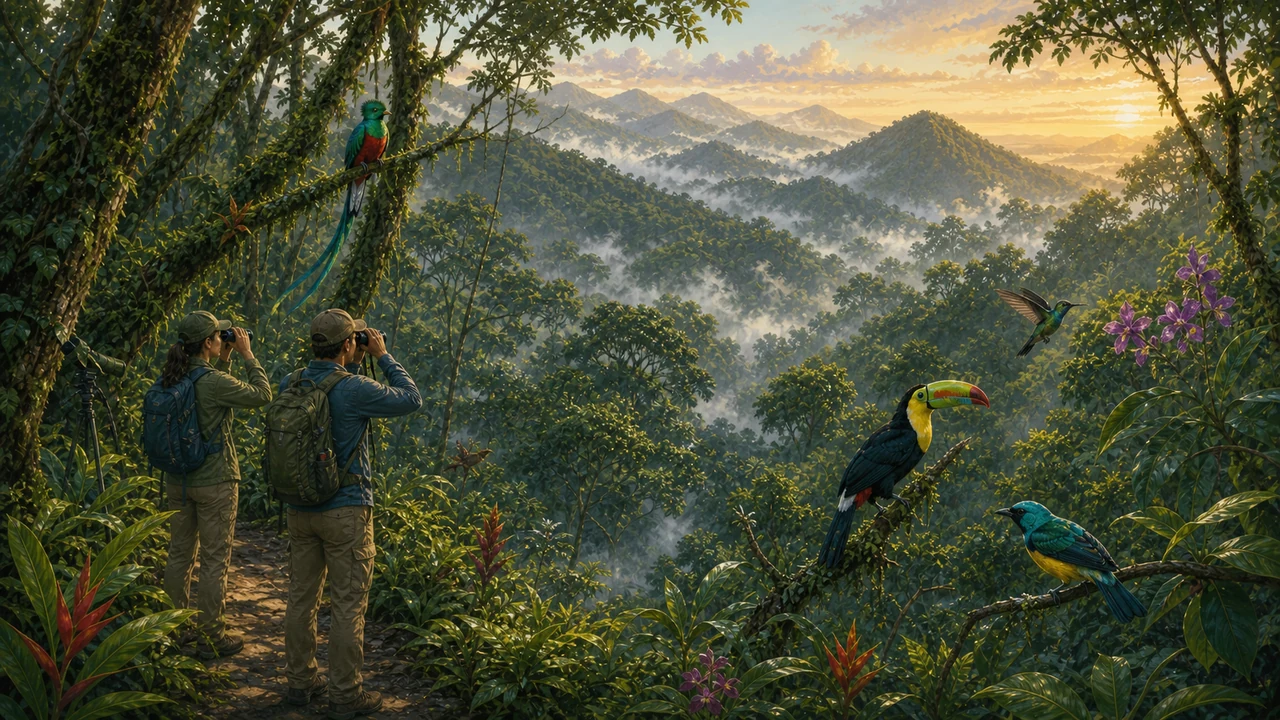 Costa Rica is one of the world’s great birding destinations, packing more than 900 recorded bird species into a country smaller than many U.S. states. That density — driven by the collision of two continents, two oceans, and a dramatic range of elevations — means birdwatching in Costa Rica rewards first-timers and veteran listers alike. From cloud-forest quetzals to lowland macaws to Pacific-coast shorebirds, every habitat reveals something new. This page is a companion to the birdwatching guide — where that page covers logistics, tours, and timing, here we focus on the birds themselves: families, iconic species, endemics, and where each is found.
Iconic Species Every Visitor Hopes to See
Resplendent Quetzal
 No bird in Costa Rica carries more mystique than the resplendent quetzal in Costa Rica’s cloud forests. The male — emerald green, crimson-bellied, with iridescent tail plumes that can exceed 60 cm — ranked among the most sacred birds in pre-Columbian Mesoamerica, its feathers prized on a level with jade and gold. The quetzal is a cloud-forest specialist, nesting in the cavities of dead trees and feeding primarily on small wild avocados (aguacatillos). The Savegre Valley near San Gerardo de Dota is arguably the most reliable spot on earth to see them; Los Quetzales National Park and the Monteverde Cloud Forest Reserve are excellent alternatives. February through May, when males are trailing their breeding plumes, is peak season.
Macaws: Scarlet and Great Green
The scarlet macaw — blazing red, yellow, and blue — is arguably Costa Rica’s most photographed bird. Scarlet macaw populations at Carara National Park have recovered significantly thanks to conservation efforts; the park sits at the transitional zone between the dry northwest and humid south, creating exceptional biodiversity. Flocks are routinely spotted flying over the Río Tárcoles bridge and the nearby forest. Further south, the Corcovado National Park on the Osa Peninsula hosts another strong population.
The great green macaw is larger, rarer, and far less often seen. It depends on the Caribbean lowlands — around Tortuguero National Park and Barra del Colorado — where it nests in the cavities of almendro trees. Habitat loss has made this one of the most threatened macaw species in Central America, but Costa Rica’s protected areas provide a critical stronghold.
Toucans and Aracaris
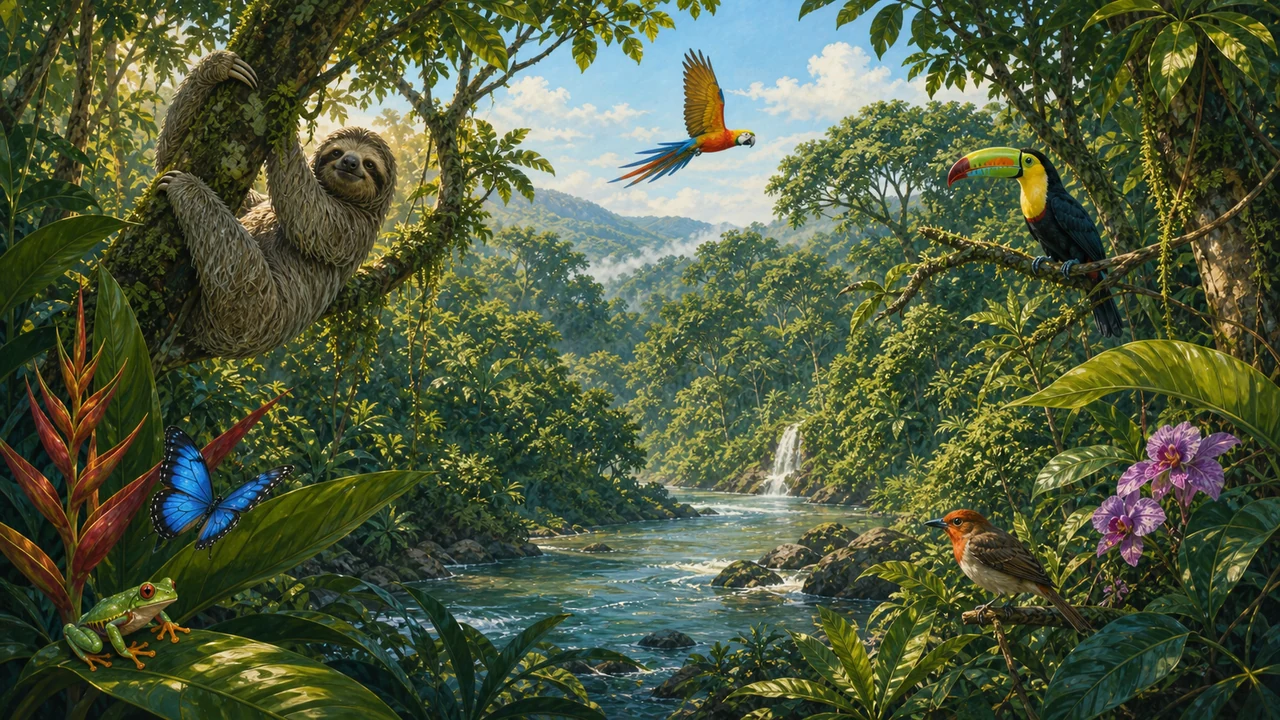 Few families announce themselves as dramatically as the toucans. Costa Rica hosts six species, ranging from the massive keel-billed and chestnut-mandibled toucans of the lowland forests to the smaller emerald toucanet of the highlands. The keel-billed toucan — with its rainbow-colored bill — is among the most recognizable birds in the tropics; it’s commonly spotted in gardens and forest edges across the Caribbean slope and around Braulio Carrillo National Park. Collared aracaris and fiery-billed aracaris round out the family, the latter being a striking Pacific-slope specialist.
Hummingbirds
Costa Rica is home to more than 50 hummingbird species — an almost absurd richness for a single country. Adaptations span every habitat: the violet sabrewing, the largest hummingbird in Central America, haunts cloud-forest flowering plants at mid-elevations; the green hermit ranges through humid lowland forest; and the mangrove hummingbird (Amazilia boucardi) is the country’s only strictly endemic species, found only in Pacific coast mangrove systems and listed as endangered.
Highland birding lodges near Cerro de la Muerte or Monteverde typically maintain feeders that attract 10 or more hummingbird species in a single morning. The coppery-headed emerald, endemic to Costa Rica and extreme western Panama, is a common target for listers visiting the Central Volcanic Range and Monteverde.
Motmots, Trogons, and Manakins
 Motmots are among the most architecturally improbable birds in Costa Rica — stocky and colorful, with pendulum-like tails whose barbs fall away to leave a distinctive racquet tip. Six species occur in the country; the blue-crowned motmot is the most widespread, found from humid lowlands to middle elevations. The turquoise-browed motmot, which appears on the national currencies of both Guatemala and El Salvador, is common in Guanacaste’s dry forests.
Trogons, close relatives of the quetzal, add further brilliance to the forest — the slaty-tailed and lattice-tailed trogons of the Caribbean foothills, the orange-bellied trogon at higher elevations. Manakins are a study in contrast: tiny, hyperactive birds of the forest understory whose males gather at leks to perform acrobatic displays. The red-capped manakin (famous for its “moonwalk” display) and long-tailed manakin are Caribbean-slope favorites.
Tanagers and Forest Flocks
Tanagers may be the most colorful family in a country already overflowing with color. Costa Rica hosts more than 50 tanager species, from the jewel-like scarlet-thighed dacnis to the bay-headed tanager to the palm tanager found in virtually every garden. Tanagers often move in mixed-species flocks alongside warblers, honeycreepers, and euphonias — a single flock passing through can deliver 20 or 30 species in minutes.
Birders in Costa Rica’s forests should watch for these mixed feeding flocks in the forest canopy, particularly in the morning hours. A related phenomenon worth knowing: army ant swarms. When migrating columns of army ants move through the forest floor, they flush insects, small reptiles, and amphibians — and a suite of bird species, particularly antbirds, tanagers, and woodcreepers, follows overhead to catch the flushed prey. Carara National Park and Corcovado are excellent places to witness this.
Waterbirds, Shorebirds, and Raptors
 Costa Rica’s wetlands and coasts add a completely different dimension. Palo Verde National Park in Guanacaste is one of the most important waterbird sanctuaries in Central America, with massive concentrations of wood storks, roseate spoonbills, herons, ibises, and ducks during the dry season. Cahuita National Park on the Caribbean coast supports jabiru storks, boat-billed herons, and a variety of kingfishers.
Among raptors, the harpy eagle — the largest eagle in the Americas — has a small but established population in lowland rainforest; Corcovado represents the best chance of an encounter. More reliably seen are the crested caracara in open Guanacaste landscapes, the white hawk of humid forests, and the king vulture, whose brilliant orange-and-white plumage makes it instantly distinguishable from the more common black and turkey vultures soaring over the forest.
Best Birding Regions in Costa Rica
The best way to understand birds of Costa Rica is by habitat. The country is compact, but every change in elevation, rainfall, and forest type creates a different bird community. A visitor can start the day with motmots and magpie-jays in the dry forest, cross the mountains for hummingbirds and quetzals, and end the trip with toucans and manakins in Caribbean rainforest.
The Talamanca highlands are the classic destination for quetzals, highland hummingbirds, silky-flycatchers, and near-endemics shared with western Panama. San Gerardo de Dota, Cerro de la Muerte, and Los Quetzales National Park are especially productive because they combine mature cloud forest, roadside access, and experienced local guides. Cool mornings are best, and even casual travelers often see species here that are difficult elsewhere in Central America.
The Caribbean slope is the richest region for sheer species totals. Sarapiqui, Tortuguero, Braulio Carrillo, and the northern lowlands hold toucans, antbirds, trogons, woodcreepers, tanagers, raptors, and wetland birds in remarkable density. Rain can fall at any time, but that moisture is exactly what supports the forest complexity birders come to see.
The Central Pacific and Osa Peninsula are essential for scarlet macaws, fiery-billed aracaris, black-cheeked ant-tanagers, and lowland rainforest species. Carara is famous because it sits at a biological transition zone where northern dry forest meets humid southern forest. Farther south, Corcovado and the Osa Peninsula offer a wilder, more immersive experience, with birding often combined with monkeys, tapirs, peccaries, and other Costa Rica fauna.
The Guanacaste dry forest is very different, and that contrast is the point. Turquoise-browed motmots, white-throated magpie-jays, crested caracaras, and dry-country flycatchers are far easier to see here than in humid rainforest. Palo Verde adds wetlands, making it one of the best places in Costa Rica for herons, storks, spoonbills, ducks, and seasonal migrants.
When to See Birds in Costa Rica
Birding is productive year-round, but the experience changes by season. The dry season, roughly December through April on the Pacific side, brings easier trail conditions, clearer mornings, and excellent access to dry forest and wetlands. Migratory species from North America are also present during much of this period, so familiar warblers, vireos, flycatchers, and orioles appear alongside tropical residents.
The green season, usually May through November, is quieter for general tourism but excellent for forest activity, breeding behavior, and photography. Mornings are often clear before afternoon rain, and the landscape is at its lushest. On the Caribbean slope, seasonality is less predictable, so travelers should plan for rain in any month and focus on early starts rather than perfect forecasts.
For target species, timing matters. Resplendent quetzals are most reliable during the nesting season, especially from February through May in cloud forest areas. Scarlet macaws can be seen throughout the year in stronghold regions such as Carara and the Osa Peninsula. Hummingbirds are present year-round, but flowering cycles can shift activity from one trail or garden to another.
Responsible Birdwatching
Costa Rica’s birding success depends on healthy habitat and respectful viewing. Stay on marked trails, keep a reasonable distance from nests, avoid flash photography around sensitive species, and use recorded bird calls sparingly. Playback can help expert guides confirm a difficult identification, but constant use can stress territorial birds, especially during breeding season.
Hiring a trained local guide is one of the best conservation choices a traveler can make. It supports communities near protected areas, improves sightings, and helps visitors understand behavior rather than simply collecting names. Many of Costa Rica’s best birding regions are also working landscapes where private reserves, family lodges, farms, and national parks together protect the corridors birds need to survive.
Endemics Worth Targeting
Costa Rica’s combination of Central American landbridge position and Talamanca highland isolation has produced a handful of true endemics and near-endemics:
- Mangrove hummingbird — the only strictly Costa Rican endemic; Pacific coast mangroves only
- Coppery-headed emerald — Costa Rica and extreme western Panama; Monteverde and Central Volcanic Range
- Black-cheeked ant-tanager — humid forest of the Osa Peninsula
- Cocos Island finch — found only on remote Cocos Island National Park, sharing that island with two other Cocos-only endemics
- Zeledonia (wrenthrush) — highland specialist, Talamanca mountains above 2,000 m
For broader ecotourism and nature experiences alongside birding — including mammals, reptiles, and amphibians — Costa Rica’s national parks and protected areas form an interconnected network covering more than 25% of the country. Detailed planning advice, including the best months to visit and how to hire a guide, is in the birdwatching guide. For broader trip planning, see Costa Rica travel tips.
Frequently asked questions
How many bird species are found in Costa Rica?
Costa Rica is home to more than 900 recorded bird species — an extraordinary number for a country roughly the size of West Virginia. That total includes both resident species and regular migrants passing through on their seasonal routes.
Where is the best place to see the resplendent quetzal in Costa Rica?
The resplendent quetzal is most reliably seen in cloud forest habitats, particularly around San Gerardo de Dota (Savegre Valley), Los Quetzales National Park, and the Monteverde Cloud Forest Reserve. The nesting season from roughly February through May offers the best sightings of males trailing their spectacular tail plumes.
Can you see scarlet macaws and great green macaws in Costa Rica?
Yes. Scarlet macaws are most easily seen in Carara National Park — where the Pacific and Caribbean climate zones meet — and along the Osa Peninsula near Corcovado. Great green macaws, the rarer of the two, are found mainly in the Caribbean lowlands, especially around Tortuguero and Barra del Colorado.
What are the endemic bird species of Costa Rica?
Costa Rica has a number of species endemic to it and neighboring Panama, including the coppery-headed emerald hummingbird, the black-cheeked ant-tanager, and the mangrove hummingbird — the country's only strictly endemic bird species, found in Pacific coast mangroves. Several highland endemics are shared with western Panama.
Do I need a guide to go birdwatching in Costa Rica?
A local guide is highly recommended. Expert guides know the precise trails, timing, and calls that make finding shy or rare species far easier. Many lodges in prime birding areas — Monteverde, the Osa, and the Talamanca highlands — have resident naturalist guides or can connect you with specialists.