All-on-4 Dental Implants Costa Rica: Cost & Guide
All-on-4 dental implants in Costa Rica attract thousands of North American patients every year who need full-mouth restoration but face four- and five-figure price gaps when treated at home. The combination of skilled, internationally trained implantologists, modern digital-dentistry equipment, and significantly lower operating costs makes Costa Rica one of the most established destinations for this procedure in the Western Hemisphere.
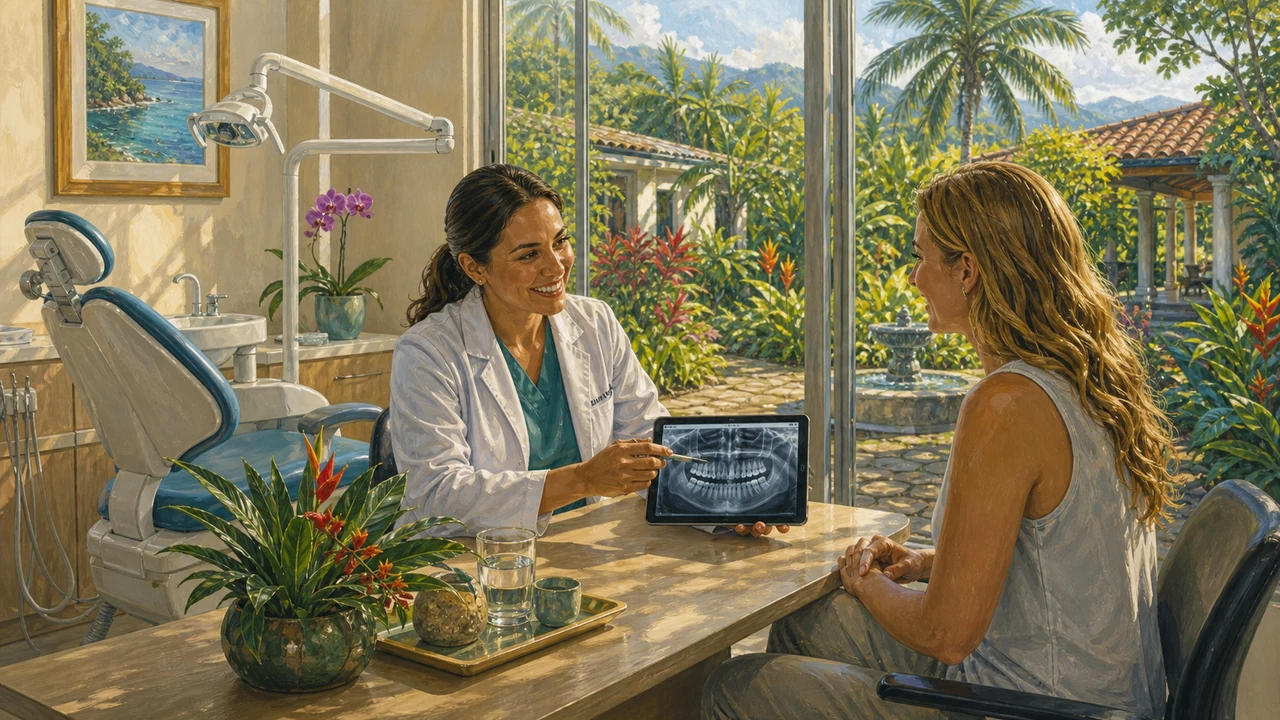
Whether you are exploring All-on-4 full-arch implants, All-on-6, or other full-mouth restoration options, this guide covers how the procedure works, what two-trip treatment typically looks like, realistic cost comparisons, what safety and quality indicators to verify, and how to plan your recovery around one of the world’s most enjoyable destinations.
What Are All-on-4 and All-on-6 Full-Mouth Implants?
All-on-4 is a fixed full-arch prosthetic system: four titanium implants are placed strategically in each jaw — two upright at the front, two angled at the back — providing enough anchor points to support a complete arch of prosthetic teeth. The angled posterior implants exploit denser anterior bone, which means many patients who would need bone grafting for individual implants can avoid it entirely.
All-on-6 follows the same principle with two additional implants per arch. The extra anchor points distribute bite force more evenly and can be beneficial when bone volume allows. Both approaches aim to deliver a fixed, non-removable restoration that functions and feels like natural teeth.
Full-mouth dental restoration in Costa Rica typically includes either implant system plus the prosthetic arch — which may be a high-strength acrylic temporary arch placed the same day as surgery (the “teeth in a day” approach) and a definitive zirconia or other advanced ceramic arch fitted after osseointegration is complete.
Who benefits most:
- Patients with multiple missing, failing, or severely damaged teeth across one or both arches
- Those who are tired of removable dentures and want a fixed solution
- Patients who have been told they need full or near-full extraction
- Anyone facing the accumulated cost of restoring many individual teeth and looking for a more predictable, comprehensive alternative
Consult a licensed, board-certified implantologist for a personal evaluation — anatomy, bone density, gum health, and systemic health factors all influence whether All-on-4 or All-on-6 is appropriate for you.
Cost Comparison: US vs Costa Rica
The table below shows typical price ranges for full-arch implant procedures. These are general market ranges, not guarantees. Costs vary by implant brand, prosthetic material, clinic fees, diagnostic workup, and case complexity.
| Procedure | Typical US Range | Typical Costa Rica Range | Approximate Savings |
|---|---|---|---|
| All-on-4 (single arch) | $20,000 – $30,000+ | $7,000 – $14,000 | Often 50–65% |
| All-on-4 (both arches) | $35,000 – $55,000+ | $12,000 – $24,000 | Often 50–65% |
| All-on-6 (single arch) | $24,000 – $35,000+ | $9,000 – $17,000 | Often 50–60% |
| All-on-6 (both arches) | $45,000 – $65,000+ | $16,000 – $28,000 | Often 50–60% |
| Temporary arch (immediate load) | Included or $3,000–$6,000 | Often included | — |
| Definitive zirconia arch | $5,000 – $10,000 per arch | $2,500 – $5,500 per arch | Often 40–55% |
Verify current quotes directly with your shortlisted clinics. Pricing shifts with exchange rates, materials costs, and clinic policy. Always request an itemized written quote that separates implant hardware, surgical fees, anesthesia, imaging (3-D CBCT cone beam scan), temporaries, and the final prosthetic.
Even after adding round-trip flights, accommodation, and incidentals for two trips, most patients report significant net savings compared to home-country treatment — and many combine recovery with leisure time in one of the world’s most beautiful tropical destinations.
The All-on-4 Process: What to Expect Step by Step

Understanding the process helps you plan realistically. Full-arch implant treatment is a multi-stage procedure, not a single appointment.
Before you travel — remote workup Most established clinics accept CBCT scans, panoramic X-rays, and dental records from your home dentist to provide a preliminary treatment plan and quote before you book flights. Send existing records; the clinic’s team will tell you what additional imaging they need on arrival.
Trip 1 (typically 7–14 days)
- In-person consultation and imaging — a 3-D CBCT scan maps your bone volume, nerve positions, and sinus anatomy. The implantologist confirms or adjusts the plan.
- Extractions (if needed) — failing teeth are removed. This may happen the same day as implant placement or at a separate appointment, depending on your case.
- Implant surgery — the four (or six) titanium posts are placed under local anesthesia; intravenous sedation is widely available and commonly used. Surgery typically takes two to four hours for a full mouth.
- Temporary arch delivery — a fixed provisional prosthesis is attached the same day or within a few days, restoring full-arch function while the implants integrate with bone. You leave with functional teeth.
- Recovery and follow-up — you remain in Costa Rica for initial healing, follow-up check-ups, and any adjustments. A soft diet is required for several weeks.
Between trips (3–6 months at home) Osseointegration — the titanium bonding with your jawbone — takes three to six months. You wear the temporary arch through this period. Most daily activities resume after 1–2 weeks. Your Costa Rica clinic may request photos or coordinate with your local dentist for interim monitoring.
Trip 2 (typically 5–7 days) The clinic verifies osseointegration via imaging, takes precision impressions or digital scans, and fits your definitive prosthetic arch — commonly full-arch zirconia, valued for its durability, natural translucency, and resistance to staining. Final bite adjustments are made before you return home.
How Many Trips, and How Long to Stay?
The standard path is two trips. Some clinics market single-trip, immediate-final protocols, but these are case-dependent. Discuss the evidence and your candidacy frankly with any provider making this claim.
For planning:
- Trip 1: Budget 10–14 days if you want unhurried recovery time; 7–8 days is often technically sufficient.
- Between trips: Continue normal life at home; stick to a soft-to-regular diet transition timeline given by your provider.
- Trip 2: Budget 5–7 days for fitting, adjustments, and final sign-off.
San José is the hub for dental tourism in Costa Rica. The city and its surrounding metro area are home to the highest concentration of internationally trained implantologists and full-service dental clinics. Juan Santamaría International Airport (SJO), in nearby Alajuela, has direct flights from dozens of North American cities, making logistics straightforward.
Recovery and Combining Treatment with a Vacation

The first week after surgery calls for rest and a soft diet — soups, smoothies, eggs, soft fish. Swelling and mild discomfort peak around day two or three and typically resolve significantly within a week. Most patients feel comfortable enough to explore San José’s restaurants, museums, and markets in the second week of their first trip.
Costa Rica is exceptionally well-suited to combining dental treatment with recovery time:
- The Central Valley’s mild climate (year-round spring-like temperatures at San José’s elevation) is comfortable for post-op patients.
- Short drives from the capital reach coffee region tours, cloud forest retreats, hot springs near volcanic areas, and quiet Pacific and Caribbean beach destinations.
- The country’s stable democracy, excellent private healthcare infrastructure, and well-developed tourism sector mean English-speaking support and logistics are readily available.
For a recovery-oriented combined trip, many patients spend the first week close to the clinic and add a few nights at a beach or mountain property before flying home. Costa Rica travel tips and packing guidance are worth reviewing before you book — the dry season (December through April) is popular but the green season offers lower costs and fewer crowds without sacrificing comfort.
Safety, Quality, and How to Choose a Provider
Is All-on-4 in Costa Rica safe? The question is reasonable — quality varies, as it does anywhere. The key is doing structured due diligence rather than booking based on price alone.
Accreditation and credentials Look for clinics affiliated with recognized international accreditation bodies or whose implantologists hold documented advanced training in full-arch protocols from accredited programs (US, European, or Latin American university-affiliated centers). Ask for credentials directly; reputable providers share them readily.
Implant systems Ask which implant brands the clinic uses. Established international systems have decades of published clinical data on long-term survival rates. Be cautious if a clinic cannot or will not identify the implant manufacturer.
Digital imaging and treatment planning A proper All-on-4 workup requires 3-D CBCT imaging, not just panoramic X-rays. This imaging guides surgical guide fabrication and reduces risk. Confirm this is part of the protocol.
Written warranties and follow-up Reputable clinics provide written warranties covering implant hardware and the prosthetic, with clearly stated terms. Ask what happens if an implant fails or the prosthetic needs adjustment after you return home — a good clinic has a protocol for remote follow-up or coordination with your local dentist.
Reviews and before/after documentation Seek verified patient reviews (not just testimonials on the clinic’s own site), documented case photos with consistent before/after presentation, and ideally direct references from prior patients willing to speak with you.
Consult before you commit. No responsible provider will finalize a full-arch treatment plan without a 3-D CBCT scan and in-person evaluation. Any clinic willing to quote a firm price and confirm you are a candidate solely from email photos deserves extra scrutiny.
For broader context on Costa Rica’s private healthcare infrastructure, the page on Costa Rica health tourism covers the country’s position as a recognized medical destination and its private hospital network.
Planning Your Trip: Practical Logistics

- Entry requirements: US and Canadian citizens need a valid passport and generally receive 90 days without a visa; check current requirements before booking via official government sources.
- Getting there: Most North American travelers fly into Juan Santamaría (SJO). International airlines serve SJO from major US, Canadian, and European hubs. Liberia’s Daniel Oduber Airport (LIR) is an alternative entry point for those who want to anchor recovery near Guanacaste’s beaches.
- Accommodation: San José and the Central Valley metro area offer a full range of accommodation from international business hotels to boutique properties and furnished apartments favored by medical tourists for extended stays.
- Currency and payments: Private clinics typically accept USD as well as Costa Rican colones; confirm payment methods and whether financing options are available.
- Health insurance and travel insurance: Your domestic health insurance almost certainly does not cover treatment abroad. Review travel insurance options that include medical coverage and, specifically, post-procedure complications — some policies explicitly cover medical tourism.
The cluster page on planning a medical trip to Costa Rica covers scheduling, pre-travel logistics, packing for recovery, and combining treatment with leisure in more detail.
Related Dental Procedures to Consider
Full-mouth implant surgery often overlaps with or leads patients to explore adjacent procedures. If your case involves single or multiple tooth replacement rather than full-arch restoration, the dental implants Costa Rica spoke covers individual and multiple-unit implant options and costs. For aesthetic work on existing teeth — porcelain veneers, crowns, or bridges — the crowns and bridges Costa Rica page covers those procedures and their cost advantages.
For the full picture of dental treatment options available to international patients, the dental tourism Costa Rica sub-pillar is your starting point. And if you are weighing which medical tourism destination best fits your needs, the medical tourism in Costa Rica pillar covers the country’s broader healthcare quality profile, accreditation, and cost landscape.
All-on-4 and All-on-6 full-mouth dental restoration can be genuinely life-changing, and doing it in Costa Rica puts that transformation within financial reach for patients who would otherwise defer treatment indefinitely. The investment in research, structured vetting, and careful planning is what separates a successful outcome from a difficult experience — take your time, get multiple written quotes, verify credentials, and ask hard questions before you book a flight.
Frequently asked questions
How much do All-on-4 dental implants cost in Costa Rica vs the US?
Costs vary by clinic, case complexity, and materials, but patients typically pay 50–70% less in Costa Rica than comparable treatment in the US. A full-arch procedure that runs $20,000–$30,000 or more per arch in the US is often quoted at a fraction of that in Costa Rica — always request itemized written quotes before committing.
Is it safe to get All-on-4 dental implants in Costa Rica?
Internationally accredited private clinics near San José use the same implant systems, digital imaging, and sterilization standards found in the US and Europe. Verify that your chosen clinic holds recognized accreditation, that the implantologist has documented training in full-arch protocols, and that written warranties cover both the implants and prosthetics.
How many trips to Costa Rica are needed for All-on-4?
Most patients complete All-on-4 treatment in two trips: the first (7–14 days) for implant placement and temporary arch delivery, and the second (5–7 days, typically 3–6 months later) for the definitive prosthetic. Some clinics offer single-trip options where a final restoration is placed immediately, but long-term outcomes depend on osseointegration; discuss the approach with your provider.
What is the difference between All-on-4 and All-on-6?
All-on-4 uses four implants per arch to support a full-arch prosthesis; All-on-6 uses six, distributing bite force across more anchor points. All-on-6 is often recommended when bone density and jaw width support the additional implants, offering a broader load distribution. A licensed implantologist will evaluate your bone structure via 3-D imaging before recommending which is appropriate.
How long does recovery take after full-mouth implant surgery?
The acute recovery period — swelling, soreness, soft-food diet — generally lasts 1–2 weeks. Osseointegration (bone fusing to the implant) takes 3–6 months before the final arch is placed. Most patients function normally with the temporary arch during this window; strenuous activity is typically restricted for 1–2 weeks post-surgery.