Cocos Island National Park — Costa Rica's Remote Dive Paradise
Cocos Island National Park (Parque Nacional Isla del Coco) protects one of the most remote and biologically extraordinary islands on Earth — a rain-soaked volcanic speck rising from the Pacific Ocean roughly 550 km southwest of Costa Rica’s mainland, offering world-class liveaboard scuba diving unlike anywhere else on the planet.
A UNESCO World Heritage Site in the Open Ocean
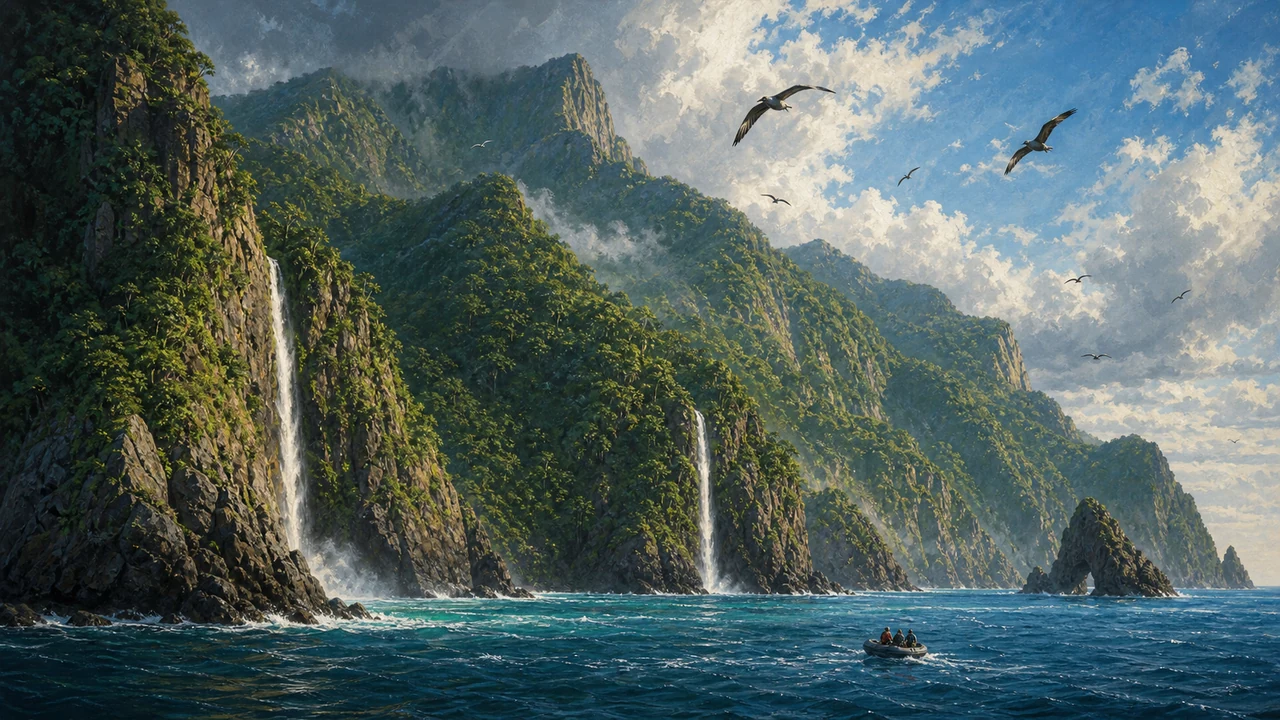 Declared a national park on June 22, 1978, and inscribed as a UNESCO World Heritage Site in 1997, Isla del Coco holds a rare distinction: it is protected not only for its land ecosystems but also for the surrounding marine environment extending 15 km outward from its shores — a Ramsar Wetland of International Importance since 1998. The island belongs to the Province of Puntarenas and is managed by SINAC (Costa Rica’s National System of Conservation Areas) through the Cocos Island Marine and Terrestrial Conservation Area (CIMTCA).
The island’s geographical coordinates place it at approximately 5°32’N, 86°59’W, making it one of the most isolated oceanic islands in the Eastern Pacific — a position that has driven remarkable levels of endemism and ecological complexity across both its terrestrial and marine habitats.
The Underwater World: Why Divers Come Here
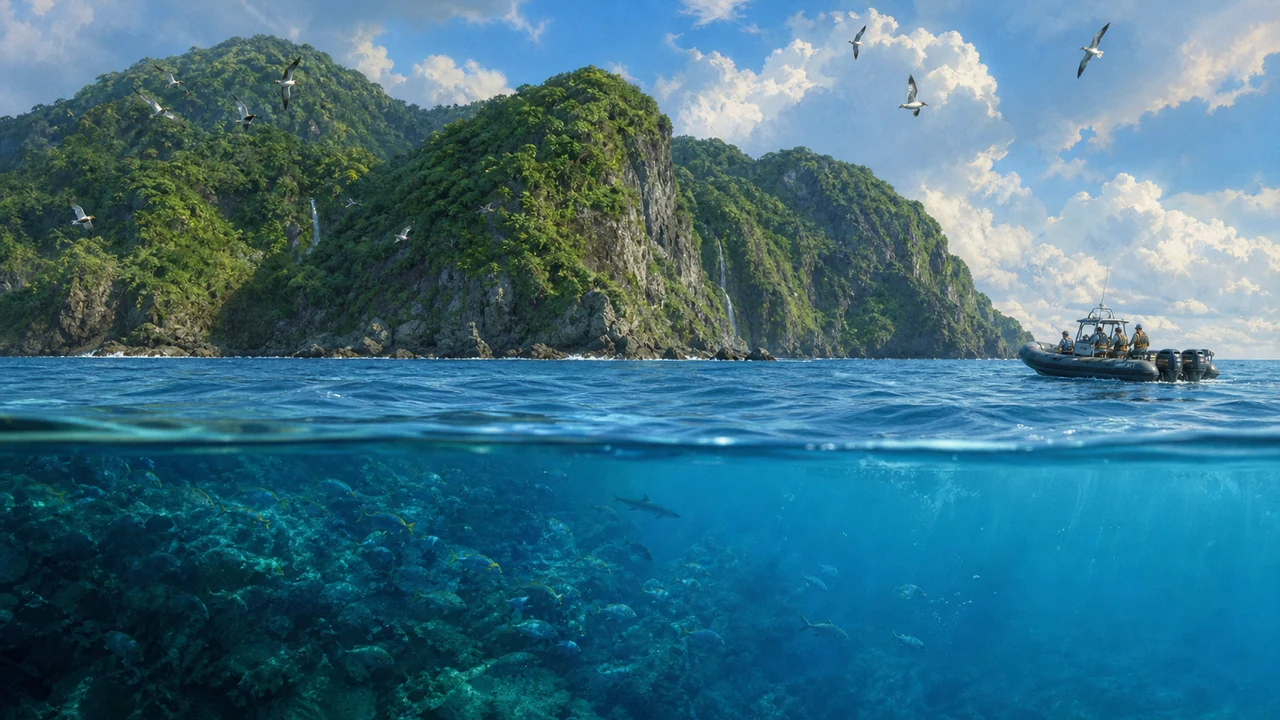 The waters surrounding Cocos Island sit at the confluence of several major ocean currents, creating an extraordinary upwelling of cold, nutrient-rich water. This draws massive concentrations of marine life that have made the island legendary among scuba divers for decades. Jacques Cousteau famously called it “the most beautiful island in the world.”
The signature experience is diving with scalloped hammerhead sharks — not just one or two, but schools of dozens or even hundreds circling in the blue water off seamounts and cleaning stations. Other encounters include:
- Whale sharks — the world’s largest fish visits regularly, especially during the wet season
- Whitetip reef sharks — so abundant they pile atop one another on the seafloor to rest
- Manta rays and eagle rays — gliding through the current-swept sites
- Bottlenose and spotted dolphins — often encountered during surface intervals
- Yellowfin tuna and wahoo — massive schools in open water
- Moray eels, lobsters, nudibranchs — the reef life is equally rich
The dive sites — names like Alcyone, Dirty Rock (Roca Sucia), Manuelita, and Dos Amigos — consistently appear on global “top dive sites” lists. Visibility can reach 30+ meters on good days, though the island’s notoriously high rainfall (over 7,000 mm annually) means conditions vary.
The Island Itself: A Living Laboratory
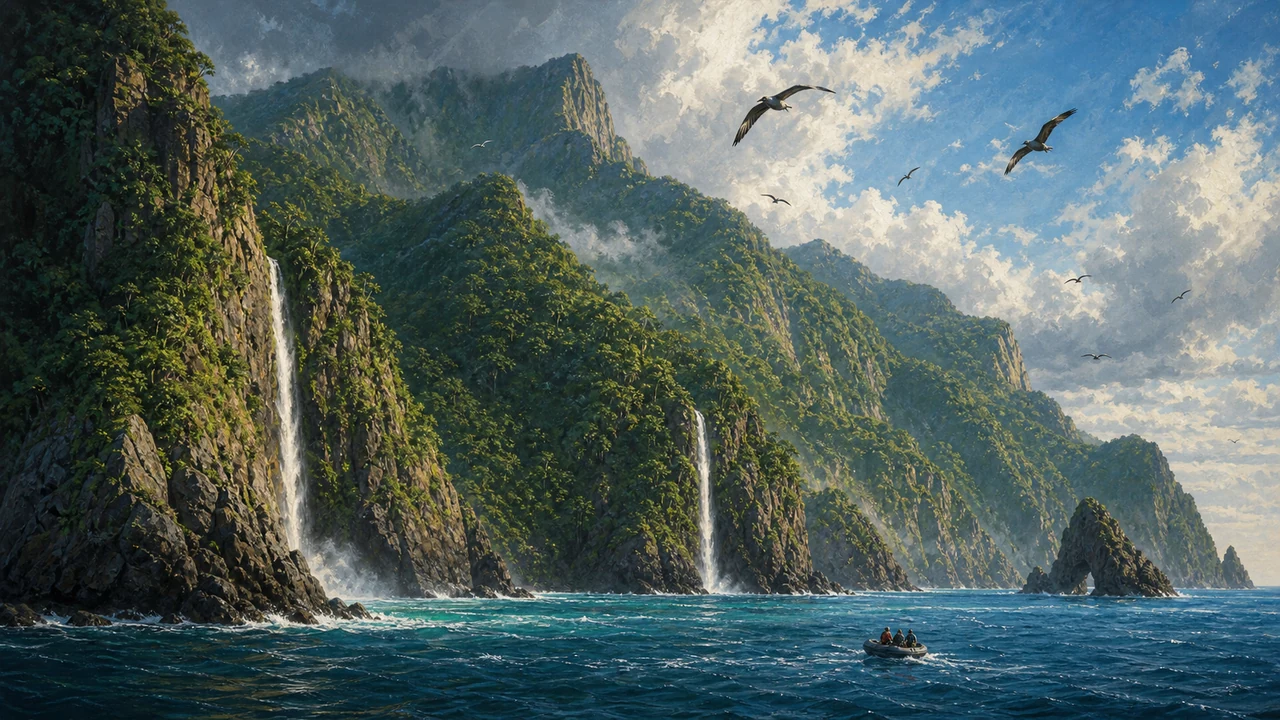 Above the waterline, Cocos Island functions as a natural laboratory for evolutionary biology. The rugged volcanic terrain — with sea cliffs rising up to 183 meters and a cloud forest interior — receives extraordinary amounts of rainfall, sustaining a lush evergreen forest year-round.
Scientists have catalogued remarkable biodiversity across the island’s relatively small land area:
- 235 species of plants, many endemic to the island
- 90 fungus species
- 97 species of birds, including the endemic Cocos cuckoo, Cocos flycatcher, and Cocos finch
- 362 species of insects
- 5 species of reptiles
- 32 species of corals in surrounding reef systems
- More than 250 species of fish in the surrounding waters
- 510 species of sea mollusks
Countless waterfalls cascade down the island’s cliffs directly into the sea, and underwater caves honeycomb the volcanic rock along the shoreline. The turquoise clarity of the water contrasts with the emerald-dark forest above — a striking visual that rewards any diver surfacing after a deep blue-water dive.
Getting There: Liveaboard Only
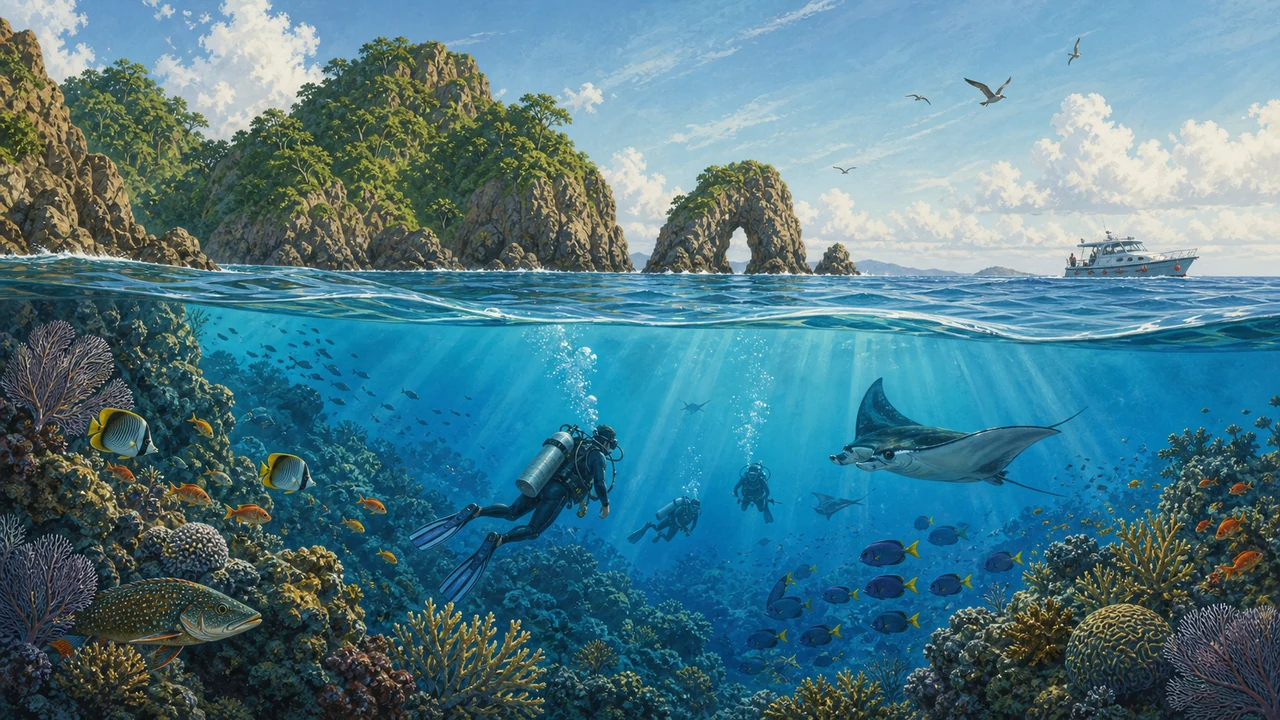 Reaching Cocos Island is an adventure in itself. The only practical access is by sea, departing from the port of Puntarenas on Costa Rica’s Pacific coast. The crossing takes approximately 32–36 hours each way depending on vessel speed and sea conditions.
Trips are operated exclusively by licensed liveaboard dive vessels. A typical itinerary runs 10–14 days from Puntarenas, allowing for roughly 5–7 full days of diving at the island before the return journey. Most operators offer 3–4 dives per day when conditions permit.
Key logistics to understand:
- No day trips exist — the distance makes it physically impossible
- No overnight tourism on land — visitors sleep aboard the boat; only rangers and researchers may stay ashore
- Park fees apply — paid through your operator as part of the package
- Advanced diver certification required — most operators require Open Water minimum, but the conditions strongly favor Advanced/Rescue-certified divers comfortable with strong currents and blue-water diving
- Book far ahead — reputable liveaboards fill months or even a year in advance
The experience is unquestionably for serious divers. Those who make the journey consistently describe it as a career-defining trip.
Conservation and Protection
Costa Rica’s commitment to protecting Cocos Island reflects the country’s broader conservation ethos — the nation protects more than 25% of its territory, a standard it has extended into the surrounding ocean. The CIMTCA designation creates an integrated framework managing both the terrestrial park and the marine protected area together.
Park rangers are permanently stationed on the island, monitoring the ecosystem, enforcing no-take zones in the marine reserve, and managing the small number of visitors permitted at any given time. Visitor quotas are strictly maintained to reduce ecological impact on this irreplaceable site.
For divers seeking to combine Cocos Island with other Costa Rican experiences, the gateway city of San José (served by Juan Santamaría International Airport) is the logical starting point. From there, the Pacific coast and Costa Rica’s national parks are within reach — including Corcovado and Manuel Antonio for terrestrial wildlife. Those interested in broader ecotourism and nature experiences will find Costa Rica offers remarkable diversity both above and below the waterline.
Cocos Island stands apart from every other destination in the Costa Rican national parks system: no beaches, no lodges, no zip lines — just raw, protected ocean wilderness and the sharks. That purity is precisely the point.
Frequently asked questions
Can I visit Cocos Island on a day trip?
No. Cocos Island is approximately 550 km off Costa Rica's Pacific coast — a roughly 32–36 hour boat journey each way. Access is exclusively via multi-day liveaboard dive vessels. There is no commercial air access to the island.
Can tourists stay overnight on the island?
Overnight stays on land are not permitted for tourists. All visitors sleep aboard their liveaboard vessel. Only park rangers and authorized scientific researchers may stay in the island's facilities.
What marine life will I see at Cocos Island?
Cocos Island is world-renowned for large pelagic encounters: schooling scalloped hammerhead sharks, whale sharks, whitetip reef sharks, manta rays, dolphins, and large schools of yellowfin tuna. The dive sites are consistently ranked among the best on Earth.
When is the best time to dive Cocos Island?
Diving is possible year-round, though conditions vary. The dry season (December–April) brings calmer seas for the crossing, while the wet season (May–November) can intensify nutrient upwelling and attract more pelagic life. Most operators run trips year-round.
How do I book a liveaboard trip to Cocos Island?
Trips depart from Puntarenas on the Pacific coast, typically lasting 10–14 days including travel time. Reputable liveaboard operators based in Costa Rica handle permits and logistics. Book well in advance — spots fill months ahead.