Costa Rica Art and Folklore
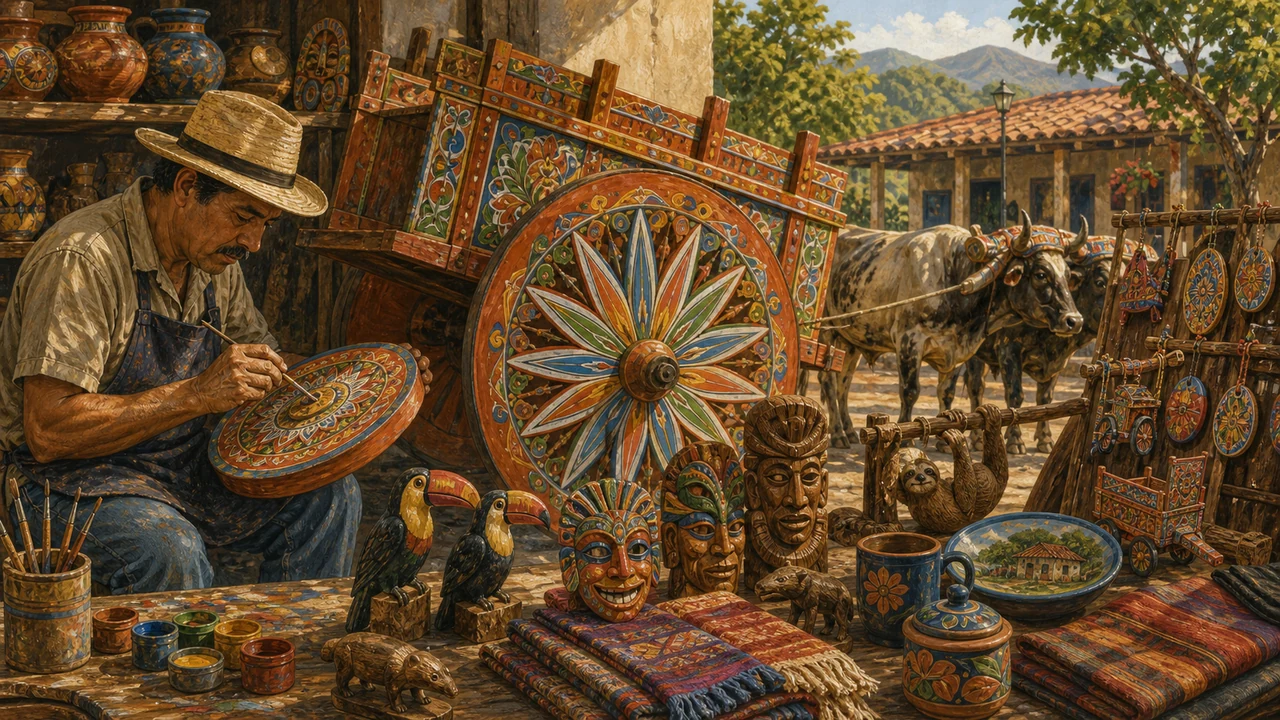
Costa Rica art and folklore are rooted in a mix of indigenous heritage, colonial history, and living craft traditions that still shape the country’s identity today. The country is small, but its artistic legacy is wide: painted oxcarts from Sarchi, Boruca masks, Chorotega pottery, pre-Columbian gold, jade, and a strong contemporary arts scene in San Jose all belong to the same story.
This hub page gathers the major traditions and points you toward deeper pages on each one.
Painted oxcarts
The painted oxcart from Sarchi is one of Costa Rica’s best-known folk symbols. What began as a practical wagon used on farms became a national emblem through bright geometric designs, careful hand painting, and generations of artisan skill.
The tradition is still alive today in both full-size carts and smaller decorative pieces. It remains one of the clearest examples of Costa Rica’s ability to turn everyday labor into art.
Indigenous art
Boruca masks and Chorotega pottery are two of the most important living indigenous art forms in Costa Rica. Boruca artisans carve masks for the Fiesta de los Diablitos, while Chorotega potters in Guaitil keep a pre-Columbian ceramic tradition active through hand-built clay work and natural pigments.
These are not static museum pieces. They are part of daily life, ceremony, and cultural continuity.
Pre-Columbian gold and jade
Costa Rica’s pre-Columbian cultures produced gold and jade objects of remarkable sophistication. Gold carried ceremonial and spiritual meaning, while jade was associated with life, power, and prestige. The museums in San Jose that preserve these collections are essential stops for anyone interested in ancient Costa Rican history.
Living craft traditions
Costa Rican artisans continue to work in wood, clay, metal, textiles, and painted surfaces. The country’s craft culture is focused rather than sprawling, but it is deeply rooted. If you visit the artisan communities, you are seeing a living tradition rather than a souvenir industry.
Explore related sections
- Costa Rica Cultural Heritage
- Costa Rica History
- Costa Rica Museums
- Costa Rica Music and Dance
- Costa Rica Literature
- Costa Rica Photography
- Costa Rica Food and Cuisine
Frequently asked questions
What is the most famous folk art of Costa Rica?
The painted oxcart from Sarchi is Costa Rica's most recognizable folk art. It began as a practical farm cart and evolved into a highly decorated symbol of national identity.
Where can I see pre-Columbian gold in Costa Rica?
The Pre-Columbian Gold Museum in San Jose holds one of the most important collections in the Americas, with hundreds of ceremonial pieces from ancient Costa Rican cultures.
What is Chorotega pottery?
Chorotega pottery is a hand-built ceramic tradition preserved in Guaitil on the Nicoya Peninsula. Artisans use local clay, traditional firing methods, and designs rooted in ancient iconography.
Are Boruca masks authentic indigenous art?
Yes. Boruca masks are carved by indigenous artisans and used in the Fiesta de los Diablitos. Buying directly from the community helps support the living tradition.
Why is jade important in Costa Rica?
Jade was a sacred and prestigious material in pre-Columbian Costa Rica. The Museo del Jade in San Jose preserves the country's largest collection of jade artifacts.