Tobías Bolaños Airport (SYQ) — Pavas, San José
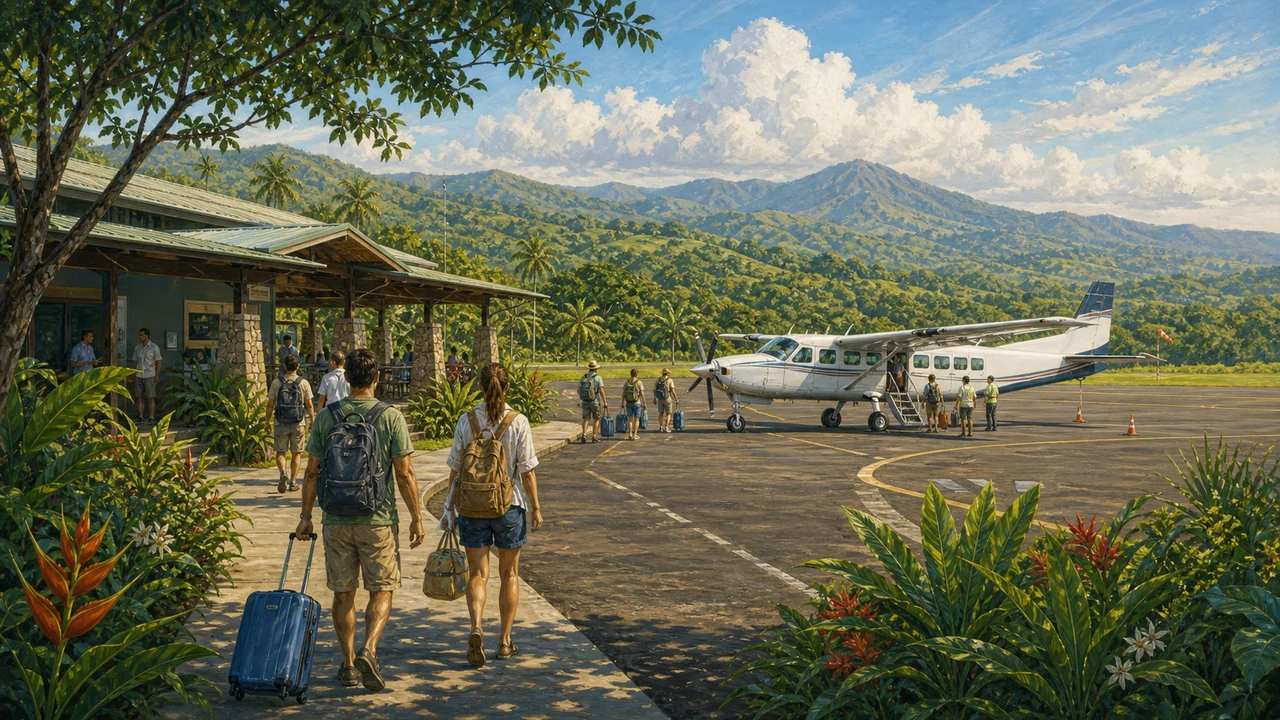 Tobías Bolaños International Airport (IATA: SYQ) in Pavas, San José, is Costa Rica’s primary hub for domestic aviation, charter flights, and general aviation services. Compact, convenient, and just minutes from the capital’s western suburbs, SYQ is the gateway that connects San José to the country’s more remote corners — places that roads reach only after long, winding drives through mountains and jungle.
If you’re planning to fly to the Osa Peninsula, Tortuguero, the Northern Zone, or any destination best reached by small plane, there’s a good chance your journey begins or ends at Tobías Bolaños.
A Brief History
The airport was inaugurated on December 21, 1975, after four years of construction. It replaced the old La Sabana airstrip, which had been reclaimed for use as a public park and sports complex — pressure from sports organizations helped accelerate the move.
The facility was named in honor of Tobías Bolaños Palma, a pioneering Costa Rican aviator who flew with the French military during the First World War. France recognized his service with a formal commendation and a lifetime pension — fitting recognition for a man who helped put a then-small Central American nation on the map of world aviation history.
What Tobías Bolaños Does (and Doesn’t Do)
 It is worth being clear about SYQ’s role in the Costa Rica aviation system. The country has two international airports handling scheduled commercial flights:
- Juan Santamaría International Airport (SJO) in Alajuela — the main gateway for international visitors flying to San José.
- Daniel Oduber Quirós International Airport (LIR) in Liberia — serving Guanacaste and the Pacific Northwest.
Tobías Bolaños handles everything else: domestic routes, charter operations, air taxis, corporate aviation, agricultural aviation, helicopter tours, and flight training. Think of it as the working airport behind San José — practical, busy, and essential to the country’s internal connectivity.
Aviation Services and Operations
SYQ is a full-service general aviation facility. Activities and services based at the airport include:
- Scheduled domestic aviation — connecting San José to regional airstrips across the country
- Charter and air taxi services — the fastest way to reach destinations like Drake Bay, Puerto Jiménez, Palmar Sur, Tortuguero, and Tambor
- Aerotours and helicopter tours — scenic overflights of the Central Valley, volcanoes, and coastlines
- Agricultural aviation — crop services for farms in the surrounding provinces
- Corporate aviation — executive charters and private jet operations
- Flight schools — training programs for fixed-wing pilots and helicopter pilots
- Aviation mechanics schools — vocational training for aircraft maintenance technicians
- Support for public institutions — including emergency management (CNE), the Red Cross (Cruz Roja), and public security forces
The airport also provides handling services, fuel and oil, customs, immigration, AIS (Aeronautical Information Service), meteorology, and security services for international charter arrivals and departures.
Airport Technical Data
 For pilots and aviation planners, the key technical specifications:
| Detail | Data |
|---|---|
| Location | Pavas, San José |
| Elevation | 1,002 m AMSL |
| Runway | 09/27 |
| Runway length | 1,600 m |
| Runway width | 23 m |
| Surface | Asphalt |
| Flight rules | VFR |
| Fuel available | JET A-1, AVGAS 100LL |
| Radio | HF and VHF |
The runway is equipped with edge lighting (white) and intersection lights (blue) for low-light operations. Its elevation and relatively short runway mean that weight and performance calculations are important considerations, particularly in the hotter months when density altitude increases.
Getting to Tobías Bolaños from San José
The airport sits in the Pavas district, just west of downtown San José — typically a 15–25 minute drive depending on traffic. The route is straightforward from the Prospero Fernández Highway (Route 27) or via Sabana-Pavas roads through the western suburbs.
There is no public bus service directly to the terminal, so most travelers arrive by taxi, rideshare (Uber operates widely in San José), or rental car. If you are catching an early morning domestic flight, confirm your timing and transport the night before — San José traffic can be unpredictable during weekday rush hours.
Flying Domestic: What to Expect
Costa Rica’s domestic flight network is one of the most practical tools a traveler has. Distances that take four to six hours by road can be covered in 30–45 minutes by air. This matters especially for:
- Tortuguero — no roads reach this Caribbean canal town; air or boat are your options.
- The Osa Peninsula — Drake Bay and Puerto Jiménez are reachable by road but the journey is long and sometimes rough.
- Remote lodges — many eco-lodges in the Southern Zone and Northern Lowlands are positioned near small airstrips precisely because guests fly in.
Luggage allowances on small domestic aircraft are strict — typically 12–15 kg (roughly 25–35 lbs) in soft-sided bags. Check your carrier’s exact limits and pack accordingly. Hard-shell suitcases are often refused on turboprop and small piston aircraft.
For broader context on moving around the country, the Costa Rica travel tips page covers ground transport, road conditions, and practical logistics. If you’re flying into Juan Santamaría first before connecting domestically, see the Daniel Oduber Airport page for comparison between Costa Rica’s international gateways.
Why Domestic Flights Often Make Sense
Costa Rica packs an enormous variety of landscapes — cloud forests, Pacific coast, Caribbean lowlands, volcanic highlands — into a country roughly the size of West Virginia. But the geography that makes it so biodiverse also makes road travel time-consuming. A single mountain range can add two hours to what looks like a short drive on a map.
Domestic flights level the playing field. You can base yourself in San José, fly to an eco-lodge near a national park, spend a few days, and fly back — without burning a full day of your trip to driving. For travelers on shorter itineraries who want to experience both coasts or multiple regions, the domestic air network centered at Tobías Bolaños is an underused asset worth knowing about.
Whether you’re a first-time visitor to Costa Rica or a returning traveler ready to explore beyond the main tourist corridors, SYQ and the domestic routes it anchors are worth building into your travel planning.
Frequently asked questions
What is the IATA code for Tobías Bolaños Airport?
Tobías Bolaños International Airport carries the IATA code SYQ. It is located in the Pavas district of San José and serves domestic routes, charter flights, and general aviation — not international commercial airline service.
Can I fly from Tobías Bolaños to popular tourist destinations in Costa Rica?
Yes. SYQ is the main hub for domestic charter operators and air taxi services connecting San José to destinations like the Osa Peninsula, Tortuguero, Tamarindo, and other remote areas. Several scheduled domestic carriers also operate from here.
Is Tobías Bolaños Airport the same as Juan Santamaría International Airport?
No. Juan Santamaría (SJO) in Alajuela handles international commercial flights to and from San José. Tobías Bolaños (SYQ) in Pavas is a separate, smaller facility focused on domestic and charter aviation.
Who was Tobías Bolaños Palma?
Tobías Bolaños Palma was a Costa Rican aviator who served with the French army during the First World War. As recognition for his distinguished service, France awarded him a lifetime pension. The airport was named in his honor when it opened in 1975.
What types of aircraft operate at SYQ?
The airport serves a wide range of general aviation aircraft — single and twin-engine Cessnas, Pipers, Beechcrafts, and turboprop Caravans are common on domestic routes, alongside helicopters used for tours and charter transfers.